Monday, 11 May 2015

5 Easy Google Analytics Tips for Web Publishers

If you’re running a blog or magazine-style website and are having success with it, you have no doubt put in a lot of hard work building an editorial process, publishing articles, and have conducted the necessary hand shaking to build your readership.
Trust us, we know how much hard work it takes to become a successful web publisher. We all started at the same place at one point. However, once you’re a successful plateau of content generation, you may find yourself wanting more… wanting to build a better experience for your users that generates more page views, more engagement, more signups, and of course, more revenue. And, that’s where really understanding Google Analytics comes in to play.
Let’s focus on three specific reporting tips that fit well for web publishers:custom dimensions, segments, and goals. Before we jump into each, let’s take a look at a few things every Google Analytics report consists of: dimension and metrics.
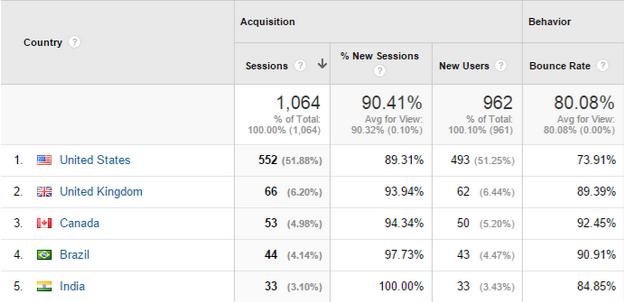
Dimensions – On the left side of your report you will view the report dimensions. Dimensions describe your data. An example of this would be the Location report (found under “Audience”). The location information you see on your left (country in this screenshot) is the dimension of the report.
Untitled document - Google Docs
Metrics – On the right side of the reports, you’ll see the metrics – quantitative measurements of your data. In the screenshot above you can see the acquisition and behavior metrics that correlate with each location dimension.

Custom Dimensions

Now that we have the basics covered, let’s jump into some of the more advanced things we can do with Google Analytics account that will give us a better understanding of how users interact with our website and content.
Now, by default Google Analytics gives us a ton of different dimensions. But, because every website is different, with varied content and users, it’s important to get specific with the kinds of reporting to make right choices for our content. This is where custom dimensions come into play – they allow the web publishers full control to generate reports that feature just about any kind of information or data set that you can think of regarding user data. A few examples of custom dimensions for web publishers are:
  • Article category: Which of your article categories is the most popular?
  • Article tags:  Which tags are your users clicking on the most?
  • Author: Who is the top author of your content?
  • Publication year: Is the current year the most popular of a previous year?
  • User login status: How do data points change for logged-in users (if enabled)?
  • Article length: What is the average length of are your most popular articles?
  • Featured image: Do users spend more time on articles with a featured image?
  • Video: How does your audience respond to posts with videos included?
Once you decide which custom dimensions best describe your content and audience, you can use those specific dimensions to learn more about readers wants/needs. Using some of the examples above, you can find out information about say, your readers’ favorite article category. Now, you may be spending all of your time crafting all of your content about “category A”, but then find out after setting up a custom dimension that “category B” is getting all the attention. Armed with this information you can now adapt to your user’s interests and create content for the preferred topic.
Another example could be content that features video. Maybe you’re not happy with the user engagement data you’re seeing in your analytics overview – time on site is short and bounce rate is high. For some reason you can’t seem to keep your users around long enough. Then you create a custom dimension that looks at your video content, and notice that compared to your overall data, time on site is way up and that bounce rate goes down. You can now make a decision on how to include more video content and create a richer experience for your users.
In order to get started with custom dimensions, you must first make sure your account has been upgraded to Universal Analytics – chances are if you’ve set this up in the last few years it already is, but an older Google Analytics installation might have to go through the upgrade process. You won’t be able to view any custom dimension data until you actually define them – Google Analytics will only track that data from the initial date of setup. You can only define a total of 20 custom dimensions in the free version of Google Analytics so choose them wisely.
Creating a custom dimension is a fairly painless two-step process.  The first step is accessing the custom dimensions tab in the admin section of your Google Analytics account; go to admin and then access the “custom definitions” drop down in the center column (labeled “properties”):

Untitled document - Google Docs (3)
Next, you will create your first custom dimension:

Untitled document - Google Docs (4)
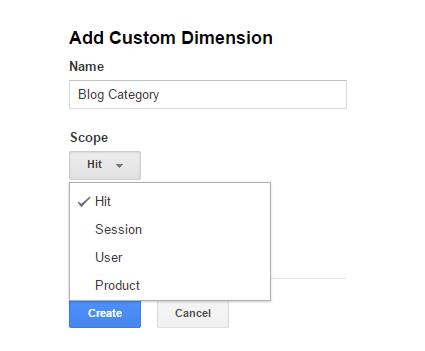
Then, you will define the type of dimension you are looking to track:
Untitled document - Google Docs (5)
The last step will require you to update your Google Analytics code to track the specific data properly. If you’re not the primary developer for your website, you’ll need to reach out to your web developer to make sure the code is properly installed. If you’re a WordPress user using, for example the popular Google Analytics plugin by Yoast, if you upgrade to premium version of the plugin you’ll be able to track custom dimensions without touching a line of code.

Segments

Next, let’s jump into segments, a tool that helps us understand our content and users. Segments are nothing more than subsets of our data and they can be applied to any Google Analytics report easily.
Let’s look at a hands-on example to explain importance of segments.
no-segments
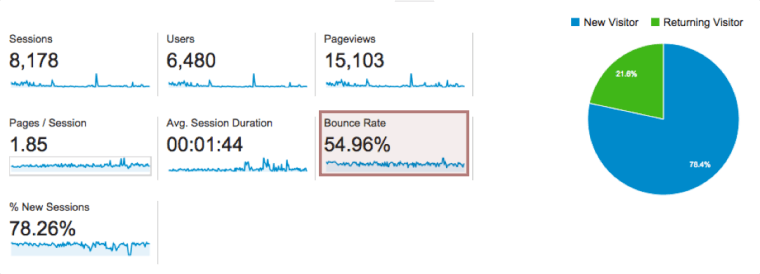
Looking at this report, we can tell that bounce rate is 54.96%. Does this mean estimating likelihood next user to visit our site will bounce at just under 55% is the best we can do? Absolutely not. And, that’s where segments come to the rescue.
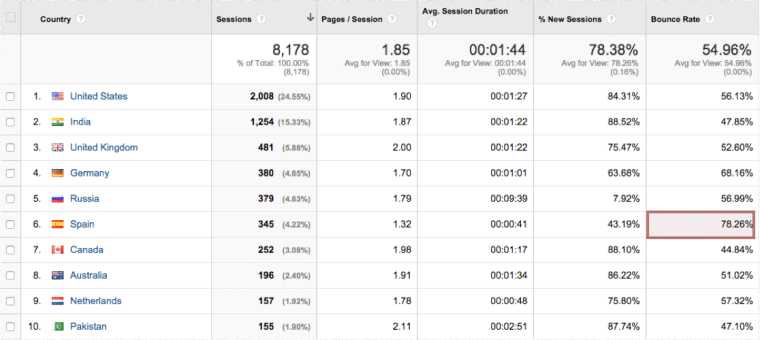
Digging deeper into our sample website data, trying to figure out why bounce rate wasn’t lower got me to audience geo-report that simply lists our top countries, ranked by number of sessions.
audience-location
You see how bounce rate for one country REALLY stands out? For some reason Spanish people hate this website. Perfect time to create our first segment. Read about the “how to’s” of building segments here. For this example, all you need to know is that segment represents a subset of traffic that’s coming from Spain.
Once you have created a segment or picked one of the built-in segments, you can apply it to your reports and see a subset of data from all reports associated with that particular segment.
spain-segment
Applying the “Spain” segment allowed me to discover something interesting. The screenshot above is from Exit Pages report (since I was looking into bounce rate) and it helps me see which pages Spanish audience is leaving my site from. Unusually high percentage of people from Spain, compared to site average, leaves my blog page. I know there’s nothing offensive to Spanish audience there, but I also happened to run across a report that says of all EU countries, Spain has lowest percentage of people able to hold a conversation in English.
That is a clue. It tells me I could probably try translating a few posts to Spanish to see if that reduces bounce rate for this particular segment, which will in turn decrease overall bounce rate. Then I can focus on another segment… and another… and another. So, instead of trying to break a bundle of sticks all at once, segments let you break them one by one. Aesop and segments for the win.

Goals

While custom dimensions and segments are extremely important in helping you gain some wonderful insight into how your user base interacts with yourcontent, unless you’re tracking goals conversions, how can you tell if your business is succeeding or failing?
Let’s take a look at the 4 types of goals you can create in your analytics account, but before we do, keep this in mind, a Google Analytics will only start tracking goal conversions after you have defined your goals. You can’t create a goal and see how many people would’ve converted on it in January 2012.

Destination Goals

Destination goal is triggered when a user visits a certain page, or multiple pages in specified order. A great destination goal example would be user visiting your “sign up for our newsletter” page, followed by that same user visiting “thank you for subscribing” page after they’ve clicked confirmation link in an email.

destination-goals

Duration Goals and Pages Per Session Goals

These two goal types are similar in sense that they both track engagement, they just do it in different ways. A duration goal will convert every time a user session lasts longer than time you specified, pages per session goal will convert whenever a session consists of “X” pages or more, “X” being number you specified when creating the goal.
They’re both easy to set up and very important for web publishers, so they are a great way for you to familiarize yourself with Google Analytics goals.

Event Goals

Finally, event-type goals are triggered when user complete an action or multiple actions you defined. These can be many different interaction with your site, but a great way to think about them is, for example, wanting to track specific clicks on an advertisement. How valuable would that information be to sponsor? Using this example you would use a line of Google Analytics code to tell analytics to trigger these clicks as an event, then set up an event goal to create the reports. Then you could track different ad placements to see how they perform against each other. Other examples of event goal tracking include goals that don’t have destination pages – download links or ajax buttons that complete a goal without sending the user to an additional web page.
event-goals

Bonus: Goals & Segments

Remember those built-in segments I mentioned earlier? Three of those are goal conversion segments and they help isolate users who convert and sessions in which conversions occurred:
  • Converters
  • Non converters
  • Sessions with conversion
By applying these to your reports you will be able to tell what it is that makes users convert. Perhaps a certain acquisition channel converts far better than others? Are there some landing pages that help conversions? Getting answers to these questions is easy if you apply one of these segments.

In Summary

If you’ve made it this far, you’re ready to jump into your analytics and start answering some of the questions you no doubt have bouncing around your head.
  • What categories of content are my users most interested in?
  • Which one of my guest authors is crushing it?
  • Do people prefer posts with videos in them?
  • Does anyone download that free PDF I spent months working on?
The list will be different for everyone, but they’re all great questions to ask.
Remember, use custom definitions to describe your content better than Google Analytics does it out of the box. Create user segments to better understand your users, and most importantly track goal conversions to know if your website fulfills its target objectives.
This process will help bring your website goals closer to your actual business goals, and you’ll develop more ability to change and adapt at a pace that will have a huge impact on revenue.


Source: http://www.searchenginejournal.com/simple-google-analytics-tips-for-web-publishers/129069/

Content Marketing & SEO: The Bigger Picture

Working to integrate your SEO and content marketing efforts? Columnist Trond Lyngbø discusses the benefits and challenges of marrying these two disciplines and explains how to succeed.


Content Marketing and SEO : The Bigger Picture
SEOs have long wondered how blog posts from Bufferapp consistently topped search engines and attracted huge audiences for free… until their content team drew back the curtains and revealed what went on behind the scenes.
Their SEO wasn’t just about traffic, conversions and revenue. Like every smart and successful marketing team, their success was based on content planning and content promotion.
In other words, by linking SEO to an effective content marketing strategy, a fairly new entrant into a hyper-competitive niche dominated search results and built a powerful brand. This report will show how you can achieve similar results in your industry.

SEO Is More Than Just Traffic, Conversions & Revenue

There are 4 key elements to an SEO plan developed around a content marketing strategy:
  1. Find out what people want and give it to them.
  2. Use retargeting lists to communicate with them, even after they leave your site.
  3. Make special price offers on your product or service if prospects act now.
  4. Evolve a smart content marketing plan to build content that pulls in your target customers.
If you look carefully, there’s nothing there which is “click/traffic” focused. All those tactical SEO elements exist, but grow really powerful when integrated into a bigger plan.
Content marketing is not paid content disguised as editorial content.
Everyone knows organic search is important to marketing strategy. Search marketers are aware of content marketing as a tactic to engage target audiences and improve search rankings. But still, in many cases, their marketing fails. Why?

What Leaders Must Know About Content Marketing & SEO

Content marketing is not paid content disguised as editorial content.
Done correctly, content marketing is an excellent way to build a relationship with customers. A well-implemented content strategy establishes trust and authority in the market. It positions your company in the middle of the research and buying cycle, so that you can take control of what they see, read, think and do.
Being found on organic search results and attracting traffic to your site makes it possible to engage people and convert them into fans and customers. And all those clicks and traffic from Google results are free.
The crucial concept behind effective content marketing, then, is to tell stories that people find interesting.
Your content should not be perceived as “marketing” or “selling.” You’ll sell more by NOT selling! While your content is designed to eventually develop awareness, close sales and create advocacy for your brand, it should stay focused on helping, creating value for customers, and meeting their needs.
This way more people will find your content, giving you wider reach and impact. Your content marketing strategy helps differentiate you from the crowd.

Content Marketing Lets You Dominate A Niche & Become The Market Leader

The business case for content marketing is clear: If you want to build your brand to become the market leader you must OWN the niches in your market.
You can achieve this goal by using keyword research and SEO analysis performed by an experienced consultant to tap into the holy grail of search behavior – a search user’s needs, questions and intent.
From current and historical data, you can find out what individuals…
  • are concerned about (fears)
  • are curious to know (interests)
  • are seeking solutions for (problems)
  • are dreaming about having (desires)
As discussed on a recent Moz Whiteboard Friday, “Know What Your Audience Wants Before Investing in Content Creation and Marketing,” it’s best to find out what your customer wants before investing in content.

Putting The Cart Before The Horse

Clients sometimes ask: “Why isn’t content marketing working for us?”
The answers are often obvious — and common across many companies and industries. Here are some of the reasons for content marketing being ineffective, and some simple ways to avoid those mistakes.

1. Weak Content Planning

Be smart about creating content. Planning your content is key. There’s nothing “new” about content marketing, even though it’s now a popular buzz word. SEO consultants have spoken about it for years, just calling it by other names. Whatever we call it, planning it is important.

2. Failing To Integrate Content Marketing Into Digital Channels

Many organizations fail to plan their digital channel marketing. Their process of ordering fresh content is seriously flawed. Investments should be greater in stories that people are actually interested in, and content that demonstrably converts better.

3. Not Realizing the Difference Between Advertising and Marketing/Content

Some organizations think content marketing is about
  • producing a piece of content
  • having people to see it
  • booking orders from convinced prospects
But really, content marketing is about
  • connecting with your audience
  • building trust
  • becoming an authority
  • being the one that they remember when it’s time to order
  • gaining mindshare as the go-to-guy or company
If your current content marketing strategy revolves around writing and distributing content “advertorials,” then it’s time for a rethink. Creating a mashup of advertising and content will only result in a low-performing piece published under the alibi of “content marketing”. You’ll pay money for advertising to lead traffic to the content, which dies down in a few weeks when the campaign ends.
Why is this practice so common, especially when it doesn’t work?

4. Lack of Knowledge About Digital Marketing

It’s easy for an agency or consultant to pander to a client’s demand for new buzzwords and services, without having to take the time and trouble to understand how the business really works.
I’m not accusing some agencies or consultants of intentionally trying to fool someone into investing in an inefficient model. But lacking the right knowledge and expertise still leads to failure, even if the actions are taken with the best purpose and intentions in mind.
Lack of knowledge about digital marketing is a problem. CMOs and strategy directors should know reasonably well how Google works, and understand intersections between organic search and other marketing in the organization’s overall strategy. Unfortunately, many are outdated when it comes to digital marketing.
This leads to their companies implementing strategies that an expert would quickly identify as useless or counter-productive. Silo-thinking condemns their content marketing strategy to mediocrity. All the while, their competitors are thriving and gaining market share.
To avoid this, you must:
  • Take research and planning seriously
  • Involve an experienced SEO consultant to uncover what people want
  • Get access to valuable historical search data
  • Ensure the content you’re creating takes you closer to your business goals.

5. Shortsightedness and Ad Hoc Work Patterns

Online digital content has a long shelf-life. But many organizations view their content marketing through a “campaign lens”.
Prioritizing and delegating are crucial skills for a CMO or strategy director. Busy with many other things, most take an ad hoc approach, focusing for a week on one thing, and on something else the week after. Whenever the going gets tough, or results are not as they hoped for, someone cracks the whip – and they become more confused and disorganized.
Instead, they should step off the hamster-wheel, review the situation and focus on whatever has worked for them already. Getting a content marketer and SEO consultant together to prioritize areas to focus on will make all activity more cost-efficient.

6. Content Overload

In the content glut of the World Wide Web, it’s tough to differentiate yourself. SEO is a great way to find more effective ways to reach your target audience and stand out from the crowd.
Content marketing is less about “content” and more about “marketing.”
If you take a shortcut and hire content writers to throw something together, and sprinkle some SEO “secret sauce” over the mess, you’ll only get a temporary quick-fix — and a bad one at that. Consulting experts at content marketing and SEO can help spot opportunities and craft content that’s interesting to customers.
Businesses should think about content marketing as inbound marketing, rather than push marketing. You must get involved, stay focused, and be consistent over time. Content marketing is a marathon, not a sprint.

7. “Campaign” Thinking

Content marketing can’t be a campaign that you launch whenever you want to sell more products. Ordering a batch of articles or advertorials just before the campaign goes live leaves little time for research and planning. Precious opportunities are lost.
Once the campaign ends, the content is forgotten — only to repeat the cycle next year. Content planning can keep your content relevant for longer, make it stronger over time, rank it better and beat your competitors on search results. That makes content marketing much more effective — and profitable.

8. Making Content The Goal

Too many organizations jump directly to production and churn out content without researching and planning it. As a result, they skip over the most important part: what the market and their prospective buyers actually want and need.
Doing this is naive and ignorant. Google has vast treasure troves of data about search volumes, trends, seasonal changes and popular search terms. Tapping this data to tailor and structure your content marketing is smart and helps you serve clients well.
Content marketing is not about what you want people to know– it’s about the needs and interests of the customer.
Your content marketing clock should tick on your customers’ schedule, not your own. Content marketing is about building and strengthening a relationship with your customers. So it shouldn’t be mistaken for advertising.

How To Find What People Want?

There are many tools to guide you.
  • Google Keyword Planner is a good starting point, where you can type in keywords and discover how popular they are.
  • Keywordtool.io is a logical second step, because it gives you more specific information about searcher intent through long tail keyword phrases.
  • SEMrush helps study what your competitors are doing. You might get ideas to expand and broaden your approach, or go deeper into sub-niches or find new ones to explore and research.

In Conclusion

I’ll leave you with some final takeaways:
  1. Investing in content marketing without SEO is sub-optimal. You will limit your own success and end up publishing content that no one is interested in.
  2. Effective content marketing will help build your brand and attract more qualified leads and paying customers.
  3. Intersections of SEO and content marketing, where experts work together, will generate better outcomes.
  4. Evergreen content lasts for years. Traffic, leads and sales will not stop when a campaign is over, but continue for many years.
  5. Content planning and content promotion can help you leverage the incredible power and longevity of content marketing and SEO.

Friday, 8 May 2015

The Amazon Change Engine

I’m a big fan of Amazon Echo. Its voice recognition capabilities are pretty amazing. I’m also completely fascinated with the impact that voice search is starting to have on natural query language. Put both of these developments together and you had me at "Hello Alexa" and "OK Google."

Nowadays, Google is distracted by many other things than justproducing relevant search results. To be certain, Google is continuing to roll out its revised mobile ranking algorithm worldwide and grow its Twitter Firehose-influenced temporal search results in line with its regular referral listings. Relevancy remains Google’s core focus – along with its avarice for being evil.
All the same, Google is also cleaving Google+ into two different parts because it just doesn’t "get" social. Google does, however, now understand the difference between streaming and photo sharing. Google is also laying Google Fiber, which should not to be confused with its wireless initiative dubbed Google Fi.
Since Google is distracted with other non-core search projects, I thought it might be interesting to take a look at another engine that is taking search relevancy very seriously. As a matter of fact, this other change engine is quietly usurping shopping market share from Google.

Basic Search
No, it’s not Bing or Yahoo. It’s not Yext or Yelp. It’s not Pintrest or Facebook. It’s Amazon online search that when combined with Amazon Echo voice capabilities, mobile devices and readers, video streaming services, and cloud computing - along with all of our personalized search and sales histories – that is quietly eating into the search pie.
Amazon is a lot of things. It is one of the top 10 U.S. retailers overall (Fortune, July 2014). Amazon net sales in 2014 totaled approximately $29.3 billion (Digital Marketing Stats, April 2015), and Amazon's worldwide paid services grew 54 percent last year (TechCrunch, Jan 2015). Amazon is also the starting place for 43 percent of online buyers, according to Media Post. When it comes to ecommerce search, Amazon is definitely eroding Google’s marketplace market share.
The big difference between the two change engines is that Amazon focuses on conversions while Google on user satisfaction. Optimizing for Amazon search means you need to focus on accurate content for feeds – in terms of structured data, and popularity – in terms of crafting content to win conversions.
Factors such as price, availability, selection, and sales history help determine where any one product appears in a customer's search results. Performance factors indicate that a product will sell well when prominently ranked only if it has a good conversion rate, is affordable, available, and has solid sales history based on "good" user reviews.
Unfortunately, sellers have indirect control over the performance factors detailed above. The search relevancy factors that digital merchandise optimizers do have complete control over include image titling and quality, product features lists and descriptions, and Amazon’s category based filtering options for size, color, price, etc., all help refine relevancy factors for the searcher.
To put it another way, Amazon’s recommendation engine is the amalgamation of positive user experiences – one that Google strives to impersonate by interpreting intent of contextual search query cues. To be certain, Amazon remains way (way) too weighted toward past purchase history when serving up personalized search results. Consequently, Amazon has to allow users to adjust their purchase histories. Amazon understands that the best way to produce relevant search results is to extend users ultimate control of their own intent. Which brings me back to voice search functionality and the Amazon Echo device.

Listening to Your Inner Voice

I’ve really enjoyed playing around with Alexa’s search functionality for weather updates, as well as preparing shopping lists, setting alarms, and other banal lifestyle features. I also enjoy the prepared music playlists, along with other new functions recently added to the device, including access to my Pandora playlists and real-time sports updates.
Yet it was Amazon’s most recent announcement that added IFTTT channel to its repertoire that made me step back and respect just how much this little tubular device is fast becoming my favorite lifestyle hack. With IFTTT coordination I don’t have to search for misplaced grocery lists or value spend weekend time sorting photos to add to Dropbox. This is another way that Amazon is acting as a change engine to make its search functionality better.
Now if "Alexa" search could only understand I want to listen to X Ambassadors' current song rather than Journey’s original version of the tune when I say "play 'Renegade,'" I’d be really impressed. Wait a minute … Amazon knows my age. Never mind! Amazon Echo’s song search functionality is spot-on.

Source: http://searchenginewatch.com/sew/how-to/2407311/the-amazon-change-engine?utm_source=feedburner&utm_medium=feed&utm_campaign=Feed%3A+sew+%28Search+Engine+Watch%29