Showing posts with label Latest Updates. Show all posts

Wednesday, 27 May 2015

Report: 75 Percent Of Google’s Mobile Search Revenue Comes From Apple Devices

Report recommends that Google will battle to keep up inquiry association with Apple.

apple-safari-1920

Fairly covered in a feeling piece at the beginning of today about the fate of Android, in the New York Times, was this stunner:

A late investigation by Goldman Sachs assessed that Google gathered about $11.8 billion on versatile pursuit promotions in 2014, with around 75 percent originating from advertisements on iPhones and iPads.

Likewise with the vast majority of these appraisals, the exact numbers are presumably not so much right yet directionally precise. Anyhow, how about we accept they're revise to keep the conversation going.

Google had recently over $59 billion in notice incomes for 2014 in light of the organization's 10-K documenting. That would mean, if the Goldman evaluations are correct, that around 20 percent of Google's income is originating from portable inquiry advertisements and about $8.8 billion from iOS gadgets.

In 2013, Morgan Stanley assessed that Google paid Apple over $1 billion every year for the benefit of being the Safari default.

As a post on Apple Insider affirms, the income reliance on iOS searchers would make Google conceivably exceptionally defenseless if Apple we're to skip the organization out of the default space on Safari and/or present its own particular internet searcher.

Undoubtedly, Apple has been associated with chipping away at quest innovation for quite a while and the organization as of late affirmed the presence of a webcrawler. The organization said as of late that AppleBot is "utilized by items including Siri and Spotlight Suggestions."

The Goldman Sachs report proposes that Google will do all that it can to keep up its association with Apple. In any case I had beforehand estimated that Google and Apple would not settle and that Bing would likely move into the default part on Safari.

This was taking into account the presumption that Google was betting it would get iPhone and iPad pursuit movement at any rate through different channels or switchers resetting Google as the default in Safari. However in the event that Google is getting about $9 of generally $12 billion in portable hunt income from Apple use it presumably would be ready to pay more than $1 billion in TAC to secure that income stream.

Research firm eMarketer has anticipated that spending on portable SEO and PPC will surpass desktop pursuit advertising spending one year from now. Much is in question for Google appropriately.

mobile search spend to overtake desktop by 2015 emarketer

We don't know unequivocally when the Apple-Google default-inquiry arrangement is up, however different reports have said its at some point this year. The Information prior reported that Microsoft and Yahoo were or are vieing for the Safari business and that Apple's Eddie Cue is overseeing the prepare off. Sources supposedly told The Information that Apple's choice will be based "on the nature of the item as much as the potential cash produced using inquiry advertisements."

The Goldman report indicates how huge Google's portable hunt business has get to be and how shockingly subordinate it is on Google's boss versatile adversary.

Postscript: We got a duplicate of the Goldman report from NY Times author Farhad Manjoo. Here are a couple of all the more verbatim portions from the archive:

~50% of this [iOS-related portable search] income, or $4.4bn, is straightforwardly identified with the Safari bargain.

By investigating Google's significant conveyance bargains, we go to a TAC rate of 65% which suggests $1.6bn in CY14 net promoting income from the Safari bargain

On the off chance that Google does not restore the Apple bargain, we evaluate that it could be ~5-10% accretive to profit if Google has the capacity recover 50-70% of income that would have fallen under the Safari bargain.

Source: http://goo.gl/OD9KDc

Tuesday, 12 May 2015

Mobile Video Ad Viewability Beats Desktop By 30 Points

Google research finds only 53 percent of PC video advertising is viewable.


video-tv2-ss-800
Last December Google released research that showed 56 percent of online display ads weren’t ever seen. This startling finding was generally consistent with older studies (e.g.,comScore) that showed a large percentage of online ads were not being seen.
Advertisers were still paying for these phantom or unseen impressions. But in a relatively short period of time viewability has become the new currency for display advertising — especially video. As set forth by the Media Rating Council and IAB, “a video ad is viewable when at least 50 percent of the ad’s pixels are visible on a screen for at least two consecutive seconds.”
Last week Google released follow-up viewability research, partly promoting its “Active View” measurement technology and partly to expose the finding that YouTube has much higher viewability rates than the industry average. This is further magnified in mobile.
Video viewability
Viewability of video ads across the web is somewhat better than general display, according to this study. Google found that the “average viewability of video ads across the web is 54 percent.” This does not include YouTube, however, where Google says, “91 percent of ads served [were] found to be viewable.”
Not surprisingly Google says that page position translates into to higher viewability. “The more prominent the position, the more viewable the ad.” The company observed, as one might expect, that larger video players also positively impact viewability. Yet, somewhat unexpectedly, mobile video advertising has much higher viewability rates than video on the PC.
Google reiterates that on YouTube more than half of all video streams are now mobile. And while overall YouTube ad viewability is 91 percent, YouTube mobile viewability is slightly higher at 94 percent.
Putting aside the self-promotional YouTube related findings, which  are probably accurate, the most interesting data here expose the significantly better viewability rates in mobile. If this finding can be replicated it will lend further ammunition to mobile advocates and help accelerate the adoption of mobile video advertising.

Bigcommerce Rolls Out Enterprise E-Commerce Platform To All

Designed for high-volume retailers, Bigcommerce Enterprise already used by major brands including Samsung, Marvel and Gibson.


bigcommerce-logo-1920
Bigcommerce has announced the general availability of Bigcommerce Enterprise, its e-commerce platform geared toward high-volume retailers. Some of the company’s clients, such as Samsung, Marvel, Schwinn and Ubisoft, have been using the platform since last year.
Today’s announcement includes several new capabilities that are available to both existing and new clients. From the company’s news release:
Bigcommerce Enterprise features advanced security and protection, real-time analytics and insights, and enterprise-grade integrations that enable online merchants the ability to manage and scale their business without the hassle of proprietary, on-premise solutions or expensive IT resources.
“Our enterprise platform delivers the functionality and scalability merchants need to compete in the big leagues, while avoiding the waste associated with managing an overly-complex, on-premise or proprietary solution,” said Eddie Machaalani, co-founder and CEO, Bigcommerce.

Link Building Never Ends

Columnist Andrew Dennis discusses how to roll with the ongoing, cyclical nature of link building -- and of digital marketing in general.


link-building-never-ends-andrew-dennis
Link building is a long-term project that never ends, and it is a natural part of the ongoing marketing cycle.
In order to remain relevant to both search engines and human beings alike, you need to regularly acquire fresh links for your website. Fresh links create exposure to new audiences and signal continuing engagement to search engines.
Building links is not a one-time, “set it and forget” type of marketing strategy. Link acquisition is an ongoing investment that helps your business, site, and brand grow over time. You shouldn’t think of link building as a short-term SEO boost; you should view links as part of your continuous marketing cycle.
More than just recognizing the ongoing need for links, it’s important to understand where link acquisition fits within the marketing cycle. Link building as a strategy targets customers at the top of the marketing funnel, but in the order of operations, links come last.

Building Links Comes Last

Seeking links will be the final process after you’ve gone through the proper steps of an online marketing campaign.
In online marketing, there is an order of operations that must be completed appropriately, step-by-step. And there are a number of processes you must implement before you begin to build links.
In a recent article on Inbound.org, my colleague Nicholas Chimonas referred to these processes as the “pre-flight checklist.” Here is a summary of the actions Nicholas covered in his post:
  • Build a user-friendly website
  • Optimize your technical and on-page SEO
  • Ensure your site is not currently being penalized
  • Perform market research
  • Create compelling and valuable content
If you haven’t taken these necessary steps, you’re not ready to start manually pursuing links.
While it is possible to acquire links without first implementing all of the above processes, those links will be ineffective for both marketing and search. Links will help new users find your site — but if your site isn’t ready to be found, all the traffic in the world won’t do any good.
Additionally, you will struggle to build the types of meaningful, quality links you need if you’re not adding value to the web. If you don’t deserve links, you’re going to have a hard time building them, and any links you do get will be questionable at best.
Respecting this order of operations will make matters much easier when you turn your focus to promoting your site.

Marketing Is Cyclical, Not Linear

Successful marketing is cyclical and ongoing.
To have long-term success, you must continuously revisit each part of the greater marketing cycle. For example, let’s look at each portion of the checklist Nicholas laid out.
  • Build a user-friendly website. Sites need to be regularly updated and often need redesigns to meet audience expectations and demands.
  • Optimize your technical and on-page SEO. On-page SEO factors require constant upkeep and ongoing management due to various changes and updates to Google’s algorithm.
  • Ensure your site is not currently being penalized. Keep an eye on traffic drops that could indicate potential penalties.
  • Perform market research. Audience behavior, competition, and market trends all typically change over time.
  • Create compelling and valuable content. Fresh content must be perpetually created, and older content updated.
An effective online marketing strategy will be cyclical, not linear. This means your marketing efforts never end, and this includes manually seeking out link opportunities.

Link Building Never Ends

Link acquisition is part of the greater online marketing cycle, and it’s an ongoing endeavor.
Link building never ends because:
  • The web is constantly evolving, and cyclical marketing will continually generate link prospects.
  • Continued content creation, in particular, will create necessary link opportunities.
  • Link rot (explanation below) requires fresh links.
  • Competitors will continue to improve and build links.
As you revisit other portions of the cycle, you will discover and generate new link opportunities. Through renewed market research, you can discover new audiences and a whole slew of fresh websites to pursue for links.
By adhering to the cyclical nature of online marketing, you will continuously be generating new content assets. As you build new assets, you will also need to promote them to earn audience attention and links. Building links may come last, but if you overlook this final step, you are missing golden opportunities for your new content — great content deserves great promotion (and great links).
Similar to on-page SEO factors, your link profile requires upkeep as well. Due to the nature of the web, “link rot” is a real issue. Many of the links to your website will become broken or dead over time, and you need to replace the lost link equity. If you’re not continuously replenishing your link profile with fresh links, you’re losing overall link equity.
Finally, link building never stops because it doesn’t stop for your competitors. Simply because you decide to stop investing in links doesn’t mean your competition will cease. If you invest in the order of operations properly, you’ll set yourself up to naturally earn some links (ideally) even if you aren’t actively building them; however, so will your competition. Manually pursuing links provides an extra boost beyond passively earning and can set you apart from your competitors.
As mentioned before, there is a sort of natural “link decay” that occurs over time, and if you’re not adding fresh links to your portfolio, you’re moving backward. However, link rot aside, if you stop pursuing links and remain stagnant, you’re still falling behind your competition.
Link building is not a short-term, quick fix. In order to have lasting impact, you must treat link acquisition as a sustained campaign and a stable part of your rotating marketing cycle. Link building never ends because effective marketing never ends.  

Recap

Link acquisition is an ongoing strategy that is contained within a larger marketing cycle.
To successfully earn worthwhile links, you must remember these key points.
Link acquisition comes last. Follow the pre-flight checklist laid out by Nicholas Chimonas before you start actively seeking links.
  • Build a user-friendly website.
  • Optimize your technical and on-page SEO.
  • Ensure your site is not currently being penalized.
  • Perform due diligence with market research.
  • Create compelling and valuable content.
Marketing is cyclical, not linear. Effective marketing is constant and cyclical; you must continuously move through each step of the cycle and repeat.
  • Sites need to be regularly updated and occasional redesigns.
  • On-page SEO requires upkeep and management.
  • Monitor traffic drops and potential penalties.
  • Audience behavior, competition, and market trends all typically change over time.
  • Fresh content must be perpetually created and older content updated.
Link building never ends. Earning links is a long-term strategy that never stops.
  • By revisiting other steps in the cycle, you will discover and generate new link opportunities.
  • Links naturally become broken or dead over time, and you must acquire fresh links to offset lost link equity.
  • Your competition isn’t going to stop pursuing links — so if you do, you will fall behind.
Rather than look for quick fixes or boosts, commit to a sustained and ongoing marketing cycle that works for your business.

Monday, 11 May 2015

Google Testing “Value Alert” Notice In Google Shopping Ads

May indicate a new way of highlighting items on sale in product listing ads.


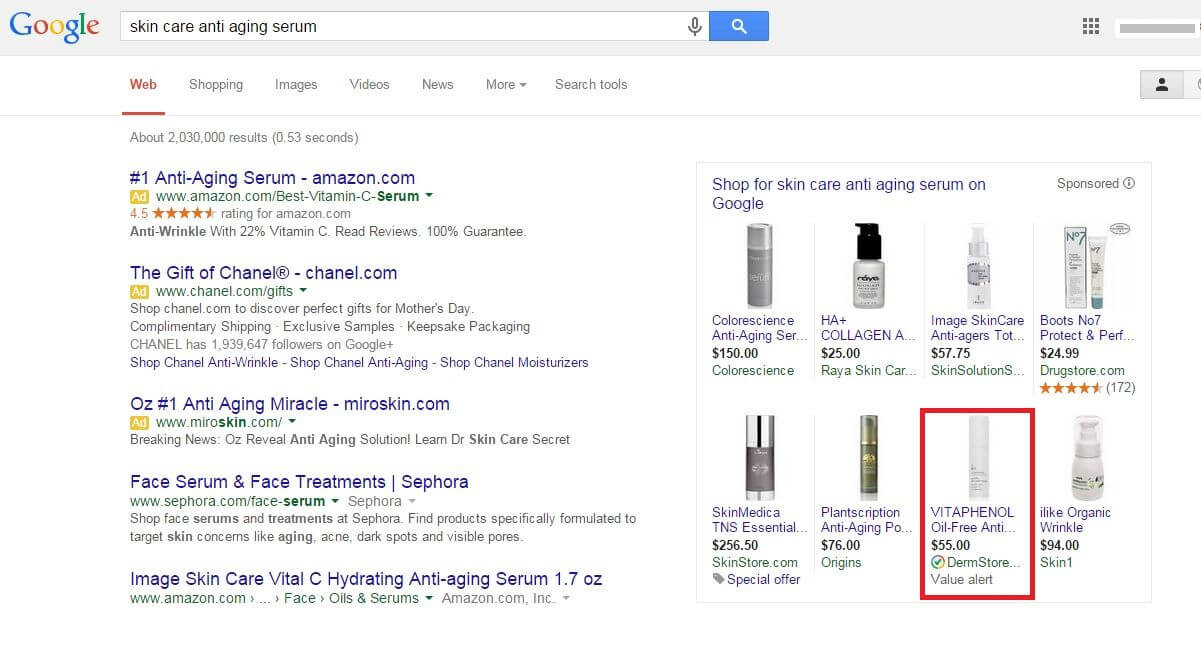
google adwords value alert notice test in google shopping ads
Google has another test running on product listing ads, this time one that highlights “value” products.
Spotted by Elizabeth Marsten at CommerceHub on Thursday, the test displays a “Value alert” message at the bottom of the ad. What’s interesting is that the ad from the DermStore does not have the lowest product price among the ads shown. The ad shown from Raya Skin Care has by far the lowest price at $25.00. Rather it may be that Google is testing a new way of showing items that are on sale or significantly discounted.
A look at the product page on DermStore.com does show sale prices on that brand (there is not a Vitaphenol serum listed on the site, though, and it’s not clear which product is showing in the search results). The “Value alert” message may only trigger based on the size of the discount; the Vitapehenol products on sale are currently discounted by 52 percent. It’s also not clear if the advertisers’ TrustedStores status has anything to do with inclusion in the test.
The experiment does appear to be very limited at this point. I haven’t been able to get it to trigger, and Marsten says she wasn’t able to get it to display again in subsequent searches.
Google declined to offer details when we asked about it, but we’ll update here if we learn anything more.

How To Acquire A New Location & Avoid Screwing Up The Local SEO

Expanding your business by acquiring a new location? Columnist Andrew Shotland discusses how to preserve its existing search equity while rebranding.


new-location-ss-1920
Acquisition of competitor locations is a common growth strategy for multi-location businesses, providing quick entry into a market, economies of scale, etc. Typically, you’ll know exactly how much you can pay for a location — unless, of course, you don’t have good understanding of how easy it is to screw up its local rankings. It’s not uncommon for an acquisition that looks good on paper to look absolutely horrible on Google, often making the price a lot higher than expected.
If you’re going to buy some new locations, you would do well to hand this to-do list over to your deal guys and whomever is managing the digital part of the transition:

1. Get The Old Domain In The Deal & Keep It Live

Goes without saying right? Wrong. I can’t tell you how many times we have been brought in post-acquisition, and the old domain (which is typically the old brand) is 404ing. The seller stopped paying the hosting bill, and the acquirer didn’t even think about it because they were going to use their brand’s domain.
There’s no quicker way to lose organic, referral, social and direct traffic than turning off the old site. At a minimum, you should 301 redirect the old site to your new site, or to the page for the new location on your site.

2. Get Old Corporate Links In The Deal

If the old brand was part of a multi-location company and had a single landing page on the corporate site, then see if your Biz Dev guys can get the seller to agree to 301 redirect the landing page on their site to the new location page on your site.
If you can’t get that, then at least see if you can get them to agree to link from their site to the new location page on your site for at least a few months after the deal closes to keep the link juice flowing during the transition.

3. Get The Old Phone Numbers In The Deal

Consistent NAP (Name, Address, Phone) data is a critical part of local SEO. When you rebrand a local business, you often go through a ranking rollercoaster as Google encounters inconsistent NAPs throughout the Web.
Keeping the phone numbers consistent can help. Also, if the business had print ads displaying phone numbers, those numbers may continue to generate leads for some time that you’ll want to capture.

4. Get Access To The Old Google My Business & Citation Pages In The Deal

It still blows my mind that, in 2015, you can spend a huge amount of money buying a business and not get the login for its Google My Business (GMB) page or its local citation profiles (e.g. Yelp, YP.com, etc.).
When you buy a car, you typically ask for the keys, right? Ask for the GMB and citation keys, too! In writing.

5. Get Access To The Old Google Analytics Data In The Deal

Funny story. A new client calls me up. Can’t get into her Google Analytics (GA) to give us the access we had requested. Turns out a former (disgruntled) employee has the login and wants $60,000 to give her access!
We worked it out with Google, and the blackmailer got bupkis. But come on, people — ask for access to the Google Analytics data… in writing! It’s easy enough to set up a new GA profile, but the historical data might be of interest to you.

6. Do NOT Mark The Old Business’ GMB Page As “Closed” *

For some reason, new owners love to mark the old brand’s Google My Business page as CLOSED. I am thinking there’s a certain perverse satisfaction in erasing the old brand from existence.
Too bad all this does is show that the place you just spent your hard-earned simoleons on is CLOSED. Remember, just because your brand is super-duper catchy doesn’t mean that people won’t still be searching for the old brand — and they’ll probably be searching for a long time.
A better strategy would be to update the old brand’s description to say that it is now known as your brand.

7. Do NOT Mark The Old Business’ Citation Pages As “Closed”

See the previous note, except now do this on every key local search site you can find like Yelp, YP.com, Abumba, etc. Fun work. Might want to use some local listings management tools for this step!

8. Update The NAP At The Main Business Aggregators First

When you update a business’ NAP information at the companies that supply the base set of business listings to many of the major local search services — Acxiom, D&B, Factual, InfoGroup, and Neustar Localeze — it can often take a long time for that data to make it out onto the Web in places Google can find. We tell clients that they should expect to see the results of data aggregator updates in about 90 days; in reality, however, many of the publishers that use this data update it sporadically, so there’s no telling when it will show up.
If you want to be really on top of your game, you may even consider updating the NAP at the aggregators before you rebrand. This could cause a bit of turbulence early on, but should make for a smoother transition once the new brand is launched.

9. Update The Old Business Citation Pages Next

Forgetting about the old brand’s citation profiles on the major local directories is one of the most common mistakes I see in rebranding. If you got the log-ins to these profiles in the deal (you got ‘em, right?), then go in and update the business name and any other pertinent info.
Make sure you note somewhere in the description that this location was formerly known as the old brand. People are still going to search for the old brand, and you want to make sure these profiles still show up on the local search sites and in Google for these queries. I have seen businesses lose a ton of lead volume instantly by no longer showing up for these old brand queries in local search sites.

10. Update The Old Google My Business Page *

Now that you have seeded the Local Search ecosystem with your new NAP, it’s time to update the old brand’s GMB page. Remember, do not mark it as “Closed.” Just update the business name and other changed NAP info, and be sure to mention the old brand name in the description.
Of course, this kind of thing never goes quite as planned, so be sure to set expectations that this will be a bit of a SEO rollercoaster ride. Good luck!

* As noted in the comments, these items are technically against Google’s guidelines and rebranding the old GMB page may get over-ridden by Google, often via Google Mapmaker editors. If the GMB page gets closed by MapMaker editors then you should try to get it re-opened and continue on with what you are doing (that’s why getting the phone number & domains is important because it supports the claim that you own the listing when they call the location). And if you just keep hitting a brick wall with this, then just create a new listing and get them merged (again, having the old phone # is key) by getting on the phone with Google Local support.

Source: http://selnd.com/1JC1YvF

15 Places You Should Be Sharing Your Blog Posts (Other Than Facebook And Twitter)

Simply writing and publishing blog posts isn’t enough. There’s so much digital noise out there today that this isn’t an “if you build it, they will come” kind of thing. Your work has only begun once you hit the “Publish” button – now, it’s time to promote your work.
For most bloggers, the natural first step is to share their content on Facebook and Twitter – but after this, many writers are at a loss. If all you’re doing is showcasing your blog posts on these sites, you’re missing out on the thousands of potential views that could come from sharing on other platforms.
Here are 15 additional places you should be sharing your blog posts:

SlideShare

Turn your blog post into a slideshow presentation using PowerPoint or other software, and share the resulting document on SlideShare. Quality content presented in this format stands out, and there’s less competition on SlideShare than on other sites.
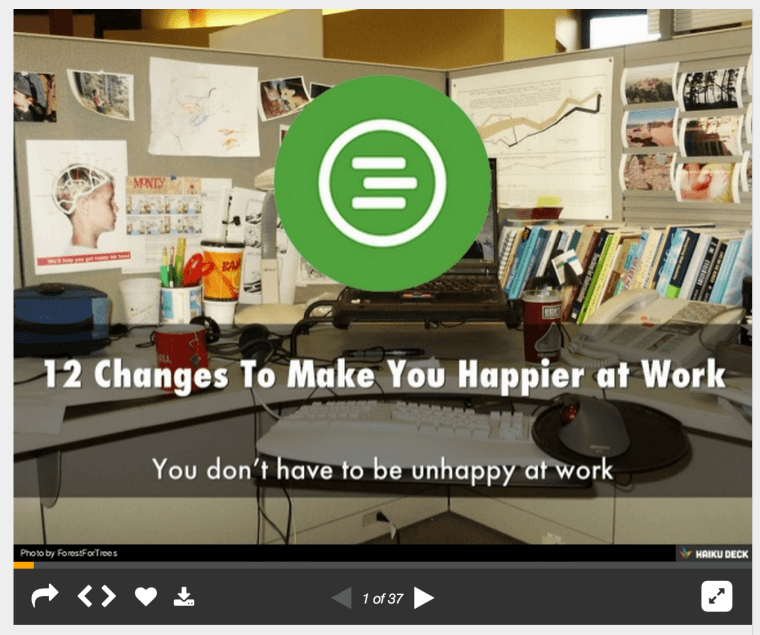
Here’s an example of a blog post that When I Work (my company) turned into a Slideshare presentation:
When I Work Example

Visual.ly

Not only is Visual.ly dedicated to helping companies create infographics and other types of visual content, it also provides a community for sharing these files. By turning your blog content into infographics or other visual content pieces and sharing them on this site, you’ll dramatically increase your blog’s exposure.

LinkedIn Groups

Sharing your content in LinkedIn Groups offers you targeted exposure beyond your usual list of connections. Just be sure the group welcomes shared content, and make sure the post is relevant to the group topic. Being perceived as a spammer on these sites won’t do any favors for your brand.

Pinterest

Pinterest’s active community makes this a great place to build traffic. By posting an attractive, relevant picture with a link to your post, your shareable image can help bring readers to you.

Instagram

Instagram is another visual sharing site similar to Pinterest – use the same strategy you’d use to get your content noticed there and on Twitter on this site. Instagram has a strong reach into the teen and young adult demographics, making it a very attractive content sharing option for brands.

Triberr

If you need traffic fast, look no further than Triberr. This platform is a social network where joining targeted “tribes” can help you build relationships with other bloggers and earn traffic by sharing others’ content.

StumbleUpon

StumbleUpon is a social network that allows users to browse random web pages by clicking the “Stumble” button. Add your content to the network, and if users like it (as noted by their ratings of your post), it’ll become more likely to appear in the random search rotation. It’s an easy way to drive credibility andincrease readership.

Google+ Communities

Google+ is another social networking tool that can be used to expand the reach of your blog. By posting into targeted Google+ communities, you’ll get your content pieces in front of interested readers in order to boost traffic. Again, though, be careful of coming off as too self-promotional. Post unique content to Google+ and be sure that any shares you post offer legitimate value to your followers.

BizSugar

If you blog about small business in some way, consider sharing your post to BizSugar. This site is designed to help bloggers share small business news and tips, making it a great place to find new readers if this is your target audience.

Your Email List

By using a lead magnet – a valuable free giveaway that’s provided in exchange for your followers’ email addresses – it’s easy to build a list of subscribers who are interested in your content and your industry. When you have new blog content, share it with your list via email. If you post frequently, consider sending weekly or biweekly updates to avoid overwhelming your subscribers with messages.

Scoop.it

Scoop.it is one of the places web users head to when they’re looking for new, interesting content, making it a great place to publish your blog posts. You can start using the program for free, but these “freemium” accounts are limited to one topic. For $11/month, you can upgrade to five topics, while business accounts with 15 topics are $67/month.

Niche-Based Social Bookmarking Sites

Depending on your particular focus, you can post to a variety of social bookmarking sites. Inbound.org, for example, is great for SEO, SMO, blogging, and internet marketing. ManageWP.org is a good place to post WordPress-related articles, while DesignFloat is perfect for web designers, and DZone is a good fit for developers.

Blog Engage

Blog Engage is a site that lets you publish blog posts on a wide variety of topics for others to read. Everything from finance to anime to cosmetics is covered, so no matter what your focus is, you can find an audience of potential new readers on this blog sharing website.

Industry-Specific Social Networks

Apart from niche-based social bookmarking sites, some industries have their own specific social networks where they share information, help each other, and offer advice. Active Rain from Trulia, for example, is a network created exclusively for Realtors. If your industry has a similar network, be sure you’re sharing your work there.

Reddit

Finally, if you have a specific niche, there’s likely a Reddit sub-forum for it. That said, Redditors (the site’s users) can be very intense, so make sure the content you share is very targeted, very high-quality and completely free of “marketing-speak”. The site has a HUGE amount of traffic, so if you can gain credibility, this can be a great source of readership for your blog.
Finding places to share your blog posts isn’t difficult – the internet is an enormous place with a tremendous number of opportunities. Just be sure that your content is relevant to the specific community you target and meets stringent quality guidelines before sharing. When you do so, you’ll discover that there are thousands of potential readers available out there for you that you’d never meet by sticking to Facebook and Twitter alone.
Are there any other online resources you use to share your content? Leave a comment below with your recommendations!

Friday, 8 May 2015

The Amazon Change Engine

I’m a big fan of Amazon Echo. Its voice recognition capabilities are pretty amazing. I’m also completely fascinated with the impact that voice search is starting to have on natural query language. Put both of these developments together and you had me at "Hello Alexa" and "OK Google."

Nowadays, Google is distracted by many other things than justproducing relevant search results. To be certain, Google is continuing to roll out its revised mobile ranking algorithm worldwide and grow its Twitter Firehose-influenced temporal search results in line with its regular referral listings. Relevancy remains Google’s core focus – along with its avarice for being evil.
All the same, Google is also cleaving Google+ into two different parts because it just doesn’t "get" social. Google does, however, now understand the difference between streaming and photo sharing. Google is also laying Google Fiber, which should not to be confused with its wireless initiative dubbed Google Fi.
Since Google is distracted with other non-core search projects, I thought it might be interesting to take a look at another engine that is taking search relevancy very seriously. As a matter of fact, this other change engine is quietly usurping shopping market share from Google.

Basic Search
No, it’s not Bing or Yahoo. It’s not Yext or Yelp. It’s not Pintrest or Facebook. It’s Amazon online search that when combined with Amazon Echo voice capabilities, mobile devices and readers, video streaming services, and cloud computing - along with all of our personalized search and sales histories – that is quietly eating into the search pie.
Amazon is a lot of things. It is one of the top 10 U.S. retailers overall (Fortune, July 2014). Amazon net sales in 2014 totaled approximately $29.3 billion (Digital Marketing Stats, April 2015), and Amazon's worldwide paid services grew 54 percent last year (TechCrunch, Jan 2015). Amazon is also the starting place for 43 percent of online buyers, according to Media Post. When it comes to ecommerce search, Amazon is definitely eroding Google’s marketplace market share.
The big difference between the two change engines is that Amazon focuses on conversions while Google on user satisfaction. Optimizing for Amazon search means you need to focus on accurate content for feeds – in terms of structured data, and popularity – in terms of crafting content to win conversions.
Factors such as price, availability, selection, and sales history help determine where any one product appears in a customer's search results. Performance factors indicate that a product will sell well when prominently ranked only if it has a good conversion rate, is affordable, available, and has solid sales history based on "good" user reviews.
Unfortunately, sellers have indirect control over the performance factors detailed above. The search relevancy factors that digital merchandise optimizers do have complete control over include image titling and quality, product features lists and descriptions, and Amazon’s category based filtering options for size, color, price, etc., all help refine relevancy factors for the searcher.
To put it another way, Amazon’s recommendation engine is the amalgamation of positive user experiences – one that Google strives to impersonate by interpreting intent of contextual search query cues. To be certain, Amazon remains way (way) too weighted toward past purchase history when serving up personalized search results. Consequently, Amazon has to allow users to adjust their purchase histories. Amazon understands that the best way to produce relevant search results is to extend users ultimate control of their own intent. Which brings me back to voice search functionality and the Amazon Echo device.

Listening to Your Inner Voice

I’ve really enjoyed playing around with Alexa’s search functionality for weather updates, as well as preparing shopping lists, setting alarms, and other banal lifestyle features. I also enjoy the prepared music playlists, along with other new functions recently added to the device, including access to my Pandora playlists and real-time sports updates.
Yet it was Amazon’s most recent announcement that added IFTTT channel to its repertoire that made me step back and respect just how much this little tubular device is fast becoming my favorite lifestyle hack. With IFTTT coordination I don’t have to search for misplaced grocery lists or value spend weekend time sorting photos to add to Dropbox. This is another way that Amazon is acting as a change engine to make its search functionality better.
Now if "Alexa" search could only understand I want to listen to X Ambassadors' current song rather than Journey’s original version of the tune when I say "play 'Renegade,'" I’d be really impressed. Wait a minute … Amazon knows my age. Never mind! Amazon Echo’s song search functionality is spot-on.

Source: http://searchenginewatch.com/sew/how-to/2407311/the-amazon-change-engine?utm_source=feedburner&utm_medium=feed&utm_campaign=Feed%3A+sew+%28Search+Engine+Watch%29