Monday, 1 June 2015

Structured Data & The SERPs: What Google’s Patents Tell Us About Ranking In Universal Search

Columnist Barbara Starr delves into several Google patents to explore the ways in which the search giant is displaying search results based on structured data and context.

gears-marketing-technology-martech-ss-1920

The use of structured data is now increasingly apparent in many aspects of search — but perhaps nowhere is it more evident than in today’s search engine results pages.
Search engine results pages have evolved considerably over the years. We’ve seen a shift from the classic “10 blue links” to an information-rich display that blends many different types of results. In addition to the standard organic search results we all know and love, we’re also seeing knowledge panels, image results, local packs, Google news, and more — each of which has its own unique algorithm for determining placement within these areas.
Google’s shift towards these “blended” search results that include Knowledge Graph-based information has had a marked effect on the search engine optimization (SEO) community. Not only do we need to start incorporating structured data into our SEO strategies, but we need to have an understanding of what factors determine which content gets displayed in different areas of the search engine results pages.
Today, I’m going to delve into some Google patents to help give you a better understanding of how the search giant is thinking about the display of search results based on structured data and context.

Ranking & Ordering Via Entity Metrics

A recent patent of Google’s, “Ranking search results based on entity metrics,” discusses the ways in certain metrics might be used by a search system (e.g. Google Search) to rank and order results.
The patent starts out by describing how a search engine algorithm works: It looks at a variety of metrics (what we typically refer to as “ranking factors”), then computes a relevance score based on a weighted sum of these metrics to determine placement within search results.
The patent also notes that “ranking search results may be distinct from ordering search results for presentation.” In other words, ranking is an internal measurement based on relevancy, whereas ordering refers to how search results are presented on a page.
So, what does this have to do with structured and entity search?
Well, the patent then goes on to describe how, in some instances, search results are based on information found within “data structures.”
In some implementations, search results are retrieved from a data structure. In some implementations, the data structure also contains data regarding relationships between topics, links, contextual information, and other information related to the search results that the system may use to determine the ranking metrics. For example, the data structure may contain an unordered list of movies, along with the awards and reviews for each respective movie. The search system may use the awards and reviews to determine a ranking of the list, and may present the search results using that ranking.
In other words, information from various external data sources (such asWikidata, a repository of structured data that helps to power Google’s Knowledge Graph) as well as structured data within your website could be used to determine search engine results page placement.
Entity-specific metrics might be used to enhance and refine this ranking/ordering process. In particular, the patent discusses four entity metrics: a relatedness metric, a notable entity type metric, a contribution metrics, and a prize metric. (Note: The patent also indicates that these 4 metrics are illustrative examples, meaning that others may also potentially be used.)
The four illustrative entity metrics are described as follows:

1. Relatedness Metric 

The relatedness metric looks at the co-occurrence of an entity and its “entity type” on web pages. An “entity type” is generally a categorization or defining characteristic of an entity — for example, George Washington is an entity, of the entity type “US Presidents.”
[W]here the search query contains the entity reference ‘Empire State Building,’ which is determined to be of the entity type ‘Skyscraper,’ the co-occurrence of the text ‘Empire State Building’ and ‘Skyscraper’ in webpages may determine the relatedness metric.
In other words, when you type in a search query, Google may determine that a web page is more or less related to that query based on what other, related words are included on the page.

2. Notable Entity Type Metric

The notable entity type metric refers to the fact that an entity may be categorized under many different entity types, some of which are more “notable” than others — for example, Barack Obama could be categorized as an Author, Politician, Public Speaker and Celebrity, but he is most notable for being a U.S. President.
barack-obama-freebase

The notable entity type metric also takes into account that multiple entities can be of the same entity type, so one in particular may be the most relevant to a searcher. For example, both George Washington and Barack Obama are of the entity type U.S. Presidents — but a Google search for “us president” yields a direct answer containing Barack Obama.
us-president-google-search
In some implementations, the value of the notable entity type metric is a global popularity metric divided by a notable entity type rank. The notable entity type rank indicates the position of an entity type in a notable entity type list.

 3. Contribution Metric (And Fame Metric)

In some cases, the contribution metric is based on critical reviews, fame rankings, and other information. In some implementations, rankings are weighted such that the highest values contribute most heavily to the metric.
It is no surprise that Google may have discovered the power and potential of something like a contribution metric and then applied that to other domains leveraging context. These are a couple of other interesting tidbits regarding reviews that the patent provides which are stated as follows:
  • “[I]nformation for determining a contribution metric may include social media, news sources, research publications, books, magazines, professional and user reviews on commerce websites, e.g. Amazon product reviews, professional and user reviews on dedicated reviewing sites, e.g. restaurant reviews on Yelp, user reviews on industry or domain specific sites, e.g. movie reviews on IMDB, any other suitable source of information, or any combination thereof.”
  • “[T]he search system may combine professional critic reviews and user reviews of restaurants, giving more weight to the professional reviews and less weight to the user reviews.”
The Fame Metric
A sub-metric of the contribution metric, the fame metric takes into account all the contributions of a particular entity. “For example, the fame metric of a movie actor may include a summation of the contribution metrics of that actor’s movies.”
Check out the search engine results page below for actor Tom Hanks. You can see below that the “contributions” involved in calculating this fame metric (in this case, his movies) are displayed prominently in the Knowledge Graph Panel in its own dedicated area, as mapped to the knowledge panel template in Google’s patent, “Providing Knowledge Panels With Search Results.”
tom-hanks-google-search
A screenshot of the Google search results page for “tom hanks.”
google-patent-fig-5b
FIG. 5B is a screen shot of an example search interface in which a knowledge panel is presented with search results. From Google’s patent, “Providing Knowledge Panels With Search Results”

4. Prize Metric

The prize metric is based on an entity’s awards and prizes. For example, a movie may have been awarded a variety of awards such as Oscars and Golden Globes, each with a particular value. In some implementations, the prize metric is weighted such that the highest values contribute most heavily to the metric.
The patent provides strong evidence that semantic web technology is being used as background context for the definitions of the metrics and the environment in which they are framed.

Different Algorithms For Different Screen Areas

There are many interesting elements to the patent, and the last I wanted to address is Figure 3.0 below.
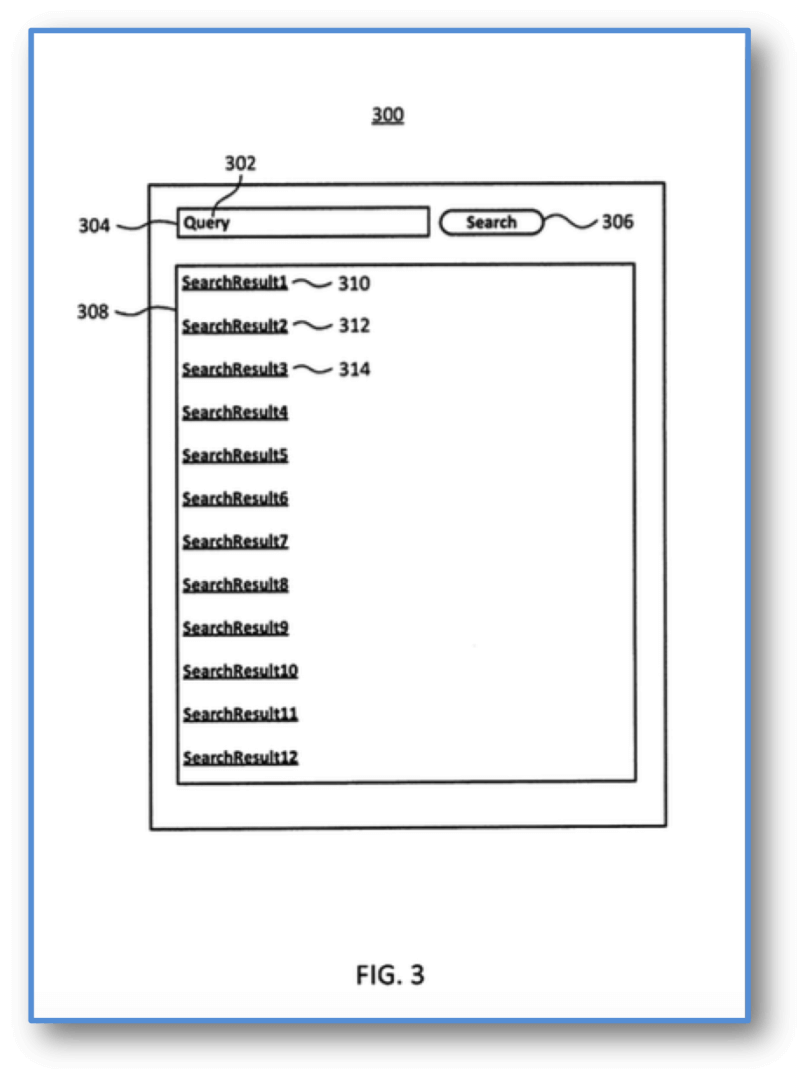
Figure 3 - Ranking Entity Metrics in Search Results Patent
Figure 3 – Ranking Entity Metrics in Search Results Patent
At first glance, it looks very innocuous, like an image of standard search results with a bunch of links. You find those sort of diagrams in many search patents. However it is accompanied by a very intriguing explanation of the figure, part of which reads as follows:
It will be understood that the presentation of search results in user interface 300 is merely an example and that any suitable presentation of any suitable results may be used. In another example, results may be image thumbnail links, ordered horizontally based on score . In another example, search results may include elements of a map and the search system uses score -* to determine which elements to present on the map.
What is interesting here is that it seems that specific regions of the search results are defined or templated in some manner, and ranking/ordering for each varies by context or domain. (Have you noted those fine lines on the screen demarcating or separating results in your search results?) From an SEO point of view, this means that optimizing a company’s website or web presence will be based on targeting these templates, each of which may well have their own ranking algorithm based on context.
As further food for thought, I would like to close with the diagram below, which shows an image from a patent on context, “Maintaining Search Context,” compared to a Google search engine results page for “golden retriever.”
Figure 10 - "Maintaining Search Results Context Patent" - and Google search results mapping
Figure 10 from Google’s “Maintaining Search Context” patent, compared to Google search results for “golden retriever.”
FIG. 10 shows user interface 1000, [which] includes exemplary content displayed in response to receiving a search query “Dog Breeds.” In some implementations, the search system displays related entity area links in the related entity area 1002, […] including “Bernese Mountain Dog,” “Poodle,” Golden Retriever,” “German Shepherd,” and “Greyhound.” The search system displays search results related to the query “Dog Breeds” in a search result area 1026. The search system displays information related to the entity “Dogs” in an information area, for example information area 1030. Information area may include links to other types of entities such as information area links 1032 to entities of the type “dog breed” and information area links 1034 to entities of the type “Service Animals.”
As you can see, different areas of the screen correspond to different result sets for the same query, presumably each with their own distinct algorithm for ranking and ordering information.

Takeaways/Summary

With the increasing shift from keyword search to entity search — and with the increased growth and usage of Knowledge Graph Panels and other data-based displays — comes the corresponding shift in the direction of SEO.
Ordering of items and ranking of information driven by a need for a positive and personalized user experience means that different algorithms apply at different times. These algorithms are based not just on traditional ranking factors that assess relevance and authority, but also by how data may be optimally visually displayed for various device types and screen sizes.

Some opinions expressed in this article may be those of a guest author and not necessarily Search Engine Land. Staff authors are listed here.

Source: http://goo.gl/soQO88

Google Maps Breakthrough: Search And Navigation Without A Connection

Offline functionality coming later this year and to iOS too.

Offline maps

Google keeps on including components and capacities that keep its maps that much in front of the opposition. Leaving I/O yesterday Google made a noteworthy declaration: Google Maps hunt and voice guided, turn-by-turn route will be accessible disconnected from the net.

This is proposed for anybody without an information association or with a frail or conflicting one. So it will be extraordinary for explorers who would prefer not to pay universal information charges or would prefer not to get a neighborhood SIM card. Anyway, all the more essentially its for creating markets and places on the planet where information associations are temperamental.

Disconnected from the net turn by turn bearings will depend on GPS. Keeping in mind there have already been disconnected from the net computerized maps, including an unobtrusive former exertion by Google and a more broad one by Nokia, this is an achievement. That is halfway due to its extension and the way that it doesn't require the client to download the guide or an area of the guide onto the telephone.

Google said amid the keynote that disconnected from the net maps will be accessible "in the not so distant future." The organization additionally let me know toward the beginning of today in email that the logged off usefulness will similarly be coming to Google Maps for iOS.

The following is the full keynote feature from yesterday. The talk of disconnected from the net Google Maps usefulness begins at 2:11:47.


Source: http://smxpo.com/1GRf7T6

Wednesday, 27 May 2015

Apple May Launch Google Now Competitor At June WWDC Event

New "Proactive" inquiry capacity based to some extent on prior Cue obtaining.

apple-store-palo-alto-1920

According to an extensive report in 9to5 Mac, Apple is going to convey to market a Google Now and potential pursuit contender, with similar "prescient inquiry" usefulness. Microsoft's Cortana additionally highlights prescient abilities that Apple's Siri needs.

The new ability, purportedly codenamed "Proactive," is based incompletely on Apple's securing of individual virtual partner Cue (established as Greplin), in late 2013 for an expected $35 million to $45 million. Like Google Now and Cortana, Cue utilized messages, contacts other on-gadget substance to present an outline of to-dos, up and coming gatherings and other data, for example, flight reservations.

As indicated by 9to5 Mac, Proactive will give time-delicate and pertinent logical data and turn into a successor to Spotlight look (despite the fact that risks are the Spotlight name will be held; Proactive is excessively near to skin inflammation prescription Proactiv).

Past the over, the new capacities will incorporate enlarged reality content in Apple Maps:

Like Google Now, Proactive will consequently give auspicious data in view of the client's information and gadget utilization designs, however will regard the client's security inclinations, as per sources acquainted with Apple's arrangements.

As a development of iOS's Spotlight inquiry highlight, Proactive is the product of a long haul activity that included the procurement of little application designers, and coordination of center iOS applications. It will likewise work with Apple's Maps application to show by and by significant purposes of enthusiasm utilizing an enlarged reality interface, and incorporate with an outsider Siri API codenamed "Breadcrumbs"

Apple may present Proactive at the inevitable Worldwide Developers Conference on June 8. Maybe most interestingly, 9to5 Mac says that, "Proactive will turn into another layer inside of the iOS working framework, supplanting the draw down Spotlight menu presently found on the iOS Home screen."

The article goes ahead to declare that the new Spotlight/Proactive inquiry capacities will be more conspicuous and available from a draw down and to one side of the homescreen. It estimates that this will "detract looks from Google's window inside of Safari."

The report contains significantly more itemized hypothesis about different new iOS usefulness and capacities. It alerts, be that as it may, that it may not all appear one month from now at WWDC.

Apple's Siri has fallen behind Google and Microsoft, without the full scope of logical and prescient right hand capacities the others have. It along these lines bodes well that Apple would look to acquaint these new components with play get up to speed. The Cue procurement proposed this over a year prior.

The more broad pursuit capacities examined in the article and whether they will indeed "take away" inquiry questions from Google all that much stay to be seen. The bigger issue is likely whether Google holds its "default" position on Safari.

As per the NY Times, "Goldman Sachs assessed that Google gathered about $11.8 billion on versatile pursuit advertisements in 2014, with around 75 percent originating from promotions on iPhones and iPads."

Source: http://goo.gl/Fetcqn

Report: 75 Percent Of Google’s Mobile Search Revenue Comes From Apple Devices

Report recommends that Google will battle to keep up inquiry association with Apple.

apple-safari-1920

Fairly covered in a feeling piece at the beginning of today about the fate of Android, in the New York Times, was this stunner:

A late investigation by Goldman Sachs assessed that Google gathered about $11.8 billion on versatile pursuit promotions in 2014, with around 75 percent originating from advertisements on iPhones and iPads.

Likewise with the vast majority of these appraisals, the exact numbers are presumably not so much right yet directionally precise. Anyhow, how about we accept they're revise to keep the conversation going.

Google had recently over $59 billion in notice incomes for 2014 in light of the organization's 10-K documenting. That would mean, if the Goldman evaluations are correct, that around 20 percent of Google's income is originating from portable inquiry advertisements and about $8.8 billion from iOS gadgets.

In 2013, Morgan Stanley assessed that Google paid Apple over $1 billion every year for the benefit of being the Safari default.

As a post on Apple Insider affirms, the income reliance on iOS searchers would make Google conceivably exceptionally defenseless if Apple we're to skip the organization out of the default space on Safari and/or present its own particular internet searcher.

Undoubtedly, Apple has been associated with chipping away at quest innovation for quite a while and the organization as of late affirmed the presence of a webcrawler. The organization said as of late that AppleBot is "utilized by items including Siri and Spotlight Suggestions."

The Goldman Sachs report proposes that Google will do all that it can to keep up its association with Apple. In any case I had beforehand estimated that Google and Apple would not settle and that Bing would likely move into the default part on Safari.

This was taking into account the presumption that Google was betting it would get iPhone and iPad pursuit movement at any rate through different channels or switchers resetting Google as the default in Safari. However in the event that Google is getting about $9 of generally $12 billion in portable hunt income from Apple use it presumably would be ready to pay more than $1 billion in TAC to secure that income stream.

Research firm eMarketer has anticipated that spending on portable SEO and PPC will surpass desktop pursuit advertising spending one year from now. Much is in question for Google appropriately.

mobile search spend to overtake desktop by 2015 emarketer

We don't know unequivocally when the Apple-Google default-inquiry arrangement is up, however different reports have said its at some point this year. The Information prior reported that Microsoft and Yahoo were or are vieing for the Safari business and that Apple's Eddie Cue is overseeing the prepare off. Sources supposedly told The Information that Apple's choice will be based "on the nature of the item as much as the potential cash produced using inquiry advertisements."

The Goldman report indicates how huge Google's portable hunt business has get to be and how shockingly subordinate it is on Google's boss versatile adversary.

Postscript: We got a duplicate of the Goldman report from NY Times author Farhad Manjoo. Here are a couple of all the more verbatim portions from the archive:

~50% of this [iOS-related portable search] income, or $4.4bn, is straightforwardly identified with the Safari bargain.

By investigating Google's significant conveyance bargains, we go to a TAC rate of 65% which suggests $1.6bn in CY14 net promoting income from the Safari bargain

On the off chance that Google does not restore the Apple bargain, we evaluate that it could be ~5-10% accretive to profit if Google has the capacity recover 50-70% of income that would have fallen under the Safari bargain.

Source: http://goo.gl/OD9KDc

Google Brings App Indexing Support To iOS Apps

iOS applications now are being upheld by Google inside of the App Indexing convention. Beginning in a couple of weeks, iOS clients may see content from applications in their portable indexed lists.

google-apple5-fade-1920

After very nearly two years of supporting, App Indexing for Android Apps, Google is now supporting iOS applications with the App Indexing convention. Google declared backing for iOS applications toward the beginning of today, with a subset of applications, as Google portrays it, "a starting gathering of applications" will be trying iOS application indexing with Google.

Application Indexing is a framework that permits individuals to snap from postings in Google's list items into applications on their Android cell phones and tablets, and now into their iOS applications on their cell phones and tablets. 

So, application designers need to add markup to their applications, present an exceptional sitemap document to Google through the Google Search Console (previously Webmaster Tools) and confirm their applications. 

Google said iOS clients will start seeing these starting gatherings of applications appear in their indexed lists both in the Google App and Chrome for marked in clients comprehensively in the advancing weeks. 


Here is a photo of how it may look:
OpenTable Side-by-side

Starting at this time, you can't get your iOS application into this gathering of applications. In any case, you can get a head begin, by setting up your application for iOS App Indexing with Google. Here is the way:


  • Add deep linking support to your iOS app.
  • Make sure it’s possible to return to Search results with one click.
  • Provide deep link annotations on your site.
  • Let us know you’re interested. Keep in mind that expressing interest does not automatically guarantee getting app deep links in iOS search results.
  • Google uses app indexing as part of their mobile ranking factor, so there is potentially a lot to gain by adding this markup.
    For more on Google App Indexing, click here.
    Postscript: Later on in the day, Google likewise reported that Google's goo.gl short connections work now backings connecting to web content as well as to application content. You can have a solitary short URL and that URL can open up either the web, iOS or Android partner. This just will work in the event that you utilize App Indexing so that Google can realize that a particular URL is interesting crosswise over web, Android and iOS.

    Beginning now, goo.gl short connections work as a solitary connection you can use to all your substance — whether that substance is in your Android application, iOS application, or site. Once you've made the essential moves to set up App Indexing for Android and iOS, goo.gl URLs will send clients straight to the right page in your application on the off chance that they have it introduced, and other people to your site. This will give extra chances to your application clients to re-draw in with your application.

    This element meets expectations for both new short URLs and retroactively, so any current goo.gl short connections to your substance will now likewise guide clients to your application.

    Source: http://goo.gl/sZYTZB

    Sunday, 24 May 2015

    Google Search Console Adds Apps Data To Search Analytics & Fetch As Google

    Google includes two new elements for App Indexing in the Search Console; Search Analytics and Fetch as Google backing.


    Google declared two new components inside of the Google Search Console, once in the past known as Google Webmaster Tools, for website admins who partake in App Indexing.

    The new components incorporate the capacity to perceive how searchers are finding the substance inside of your local Android applications through Google seek in the Search Analytics report. Besides the capacity to perceive how Google sees your application content through an alpha rendition of Fetch as Google for Apps.

    This shocks no one as Google was looking for beta analyzers for these new components in the no so distant past.


    The essential for this is that you (1) need to have an Android application, (2) open Search Console and enter your application name: android-app://com.example., (3) have a related application to a site in the support and (4) obviously present the XML feed. At that point you can profit by these new components.

    Search Analytics For Apps

    The Search Analytics report will give you really point by point data on top questions, top application pages, and activity by nation for your application. It has all the typical channels that you'd see for site content yet it applies to your application including separating by particular question sort or area, or sort by snaps, impressions, CTR, and positions.
    Search Analytics for apps

    Fetch As Google For Apps

    Ever consider how Google sees the substance inside of your Android application? Google composed a beta form of the Fetch As Google for Apps to give App designers experiences into this. It will demonstrate to you by application URI how Google renders the URI. Here is a photo of how one application may resemble:

    fetch as google for apps

    Friday, 22 May 2015

    Why Mobile Programmatic Is The Next Frontier

    Despite its initial technical hurdles, mobile programmatic is set to be a game changer. Columnist Alex LePage explains why.
    mobile-phones-tablets-ss-1920

    Perhaps it was inevitable that programmatic buying would begin to take off on mobile. After all, mobile advertising is growing faster by the year, and programmatic, which is expected to be a $20 billion industry by the end of 2016, is showing no signs of slowing down.
    And yet it wasn’t all that long ago that many marketers doubted whether mobile programmatic could truly work. Savvy programmatic marketers certainly recognized the promise of bringing programmatic’s unique targeting efficacy to mobile, but the general absence of cookies on mobile created technical hurdles that some saw as insurmountable.

    Marketers Falling Behind On Mobile Programmatic

    The uncertainty about the technology perhaps explains why some marketers have fallen behind when it comes to mobile programmatic. The Interactive Advertising Bureau’s (IAB) recently released “Marketer Perceptions of Mobile Advertising” report, which surveyed more than 200 marketers, found that more than three-quarters of marketers believe that programmatic mobile is important, or at least somewhat important.
    The surprising part? Only 27 percent of the marketers surveyed had actually purchased mobile ads programmatically.
    The good news for the programmatic industry, and for marketers as a whole, is that the technical hurdles that once prevented programmatic targeting on mobile are now largely a thing of the past.
    variety of solutions have emerged to solve mobile’s cookie problem: client log-in, app SDKs (Software Development Kits), and mobile Web behavioral data to name a few. Tie a shiny bow around all of that with geo-location, and we’ve begun to master mobile.
    So it’s a safe bet that when the IAB conducts next year’s survey on mobile advertising, the percentage of marketers who have purchased mobile ads programmatically will be far greater. Indeed, eMarketer projects that mobile will account for over half of all programmatic spending by the end of 2015, surpassing desktop.
    eMarketer Programmatic Mobile

    Mobile Programmatic’s Real Promise

    Why do eMarketer and plenty of others anticipate such rapid growth for mobile programmatic? For one thing, brands that have had great success with programmatic marketing on desktop simply can’t afford to ignore mobile if they want to reach their customers.
    Next year the number of people across the globe who use smartphones is expected to exceed 2 billion, and it’s no secret that we’re spending more and more time on our phones and other devices. Turning to mobile programmatic, in other words, is essential for marketers who want to keep up with the ways people interact with technology.
    But to suggest that mobile programmatic is only about keeping up is to miss the true promise of combining sophisticated targeting with mobile devices.
    Brands can gather data and intelligence about their customers that is much more thorough on mobile than on desktops. The data collected from mobile is also much more complete than from desktops. This speed and thoroughness can make the critical difference between a conversion and a missed opportunity.
    And that’s really just the beginning of what’s possible with mobile programmatic. While most marketers are presumably aware that mobile programmatic offers improved geo-targeting, what some marketers don’t yet know is that mobile programmatic now makes it possible to target users even based on where they are within a store.
    Imagine a cereal brand serving an ad with a discount to a consumer as he or she walks down the cereal aisle, and you begin to get a sense of how mobile programmatic will be not only a hot trend, but a true game changer.
    The takeaway is clear enough — or at least, it should be: Mobile programmatic will play a leading role in connecting more effectively with consumers. The information we can now glean through client log-in data, app SDKs, mobile Web behavioral data, and most importantly, geo-location presents us with a very clear picture of consumer interest.
    A surprising number of marketers haven’t yet caught up to this new reality. When those marketers connect the data, mobile programmatic’s growth may surprise us all again.
    Source: http://mklnd.com/1JDjO3E

    Wednesday, 20 May 2015

    Google Maps Lists The White House & Howard University For Racists Terms

    Where previous Google Maps hacks were arguably playful, this is ugly.

    Maps n-king Google

    It’s one thing to see pictures of Android mascots urinating or references to Edward Snowden on Google Maps, it’s quite another to see it used as a tool of racism. That’s what happened this afternoon as selected racist queries on Google Maps point to the Obama White House.
    The story comes from several sources but is laid out in the Washington Post. I couldn’t reproduce the all the results being discussed but when I searched on “n— king, Washington DC” the White House is the result.
    Apologizing for the recent spate of problems, but especially this one, Google offered the following official comment:
    Some inappropriate results are surfacing in Google Maps that should not be, and we apologize for any offense this may have caused. Our teams are working to fix this issue quickly.
    Google had previously shut down Map Maker to try and prevent just these sorts of problems and mapspam from arising. But these examples are not related to Map Maker, Google tells us.
    Google deals with scores of hack attempts on Maps all the time and it prevents the majority from showing up. However when one like this gets though it gets a great deal of attention and serves to encourage copy cats. In the absence of the urinating mascot and Snowden incidents this unfortunate episode might not have happened.
    Postscript (May 19): Either the same racist hacker has struck again or it’s a copycat. According to a post by Bryan Seely, this historically black Howard University now shows up as “N–er University” in Google Maps.
    Postscript 2 (May 20, 3:30pm ET): As the Huffington Post points out, a different spelling of the N-word will bring up the White House on Google Maps. We’ve verified this still works. Entering that word plus “house” into Google Maps, even from California, zooms directly into the White House:
    white house racist term in google
    We’ve also updated the date on our story from May 19, to reflect changes since we originally published.
    Postscript 3 (4pm ET): We’re investigating further with Google to better understand exactly how this happened. It doesn’t appear to be something an edit that Map Maker could have caused, but we’re checking.
    If not, then what did happen? One thing is that with the White House, it could simply be that the White House will rank for any term that uses the word “House” in it, if you are in the Washington DC area or have your map set to that location.
    For example, testing with a slur against Asians will bring the White House up. Searching for “bulls**t house” also brings it up (in the Los Angeles area, that ranks the Coachella music festival as a top listing).
    Another thing that could be happening is that because of Google’s use of web-wide data for local results, part of its Pigeon Update last year, references people make across the web could be influencing how local sites are ranking. For example, a search for a slur against Latinos plus “house” in the DC area brings up Hispanic Link DC.

    Tuesday, 19 May 2015

    The Google-Twitter Deal Goes Live, Giving Tweets Prominent Placement In Google’s Results

    Tweets now appear for trending topics in a new carousel format. Twitter doesn't earn directly off display but will gain new traffic.


    twitter-google-logos2-1920

    The deal between Google and Twitter to bring more tweets into Google’s search results announced earlier this year is finally delivering on its promise. Google is now showing tweets in a new and more graphical way on mobile devices, with desktop promised soon.

    Tweets In Carousel, With Images

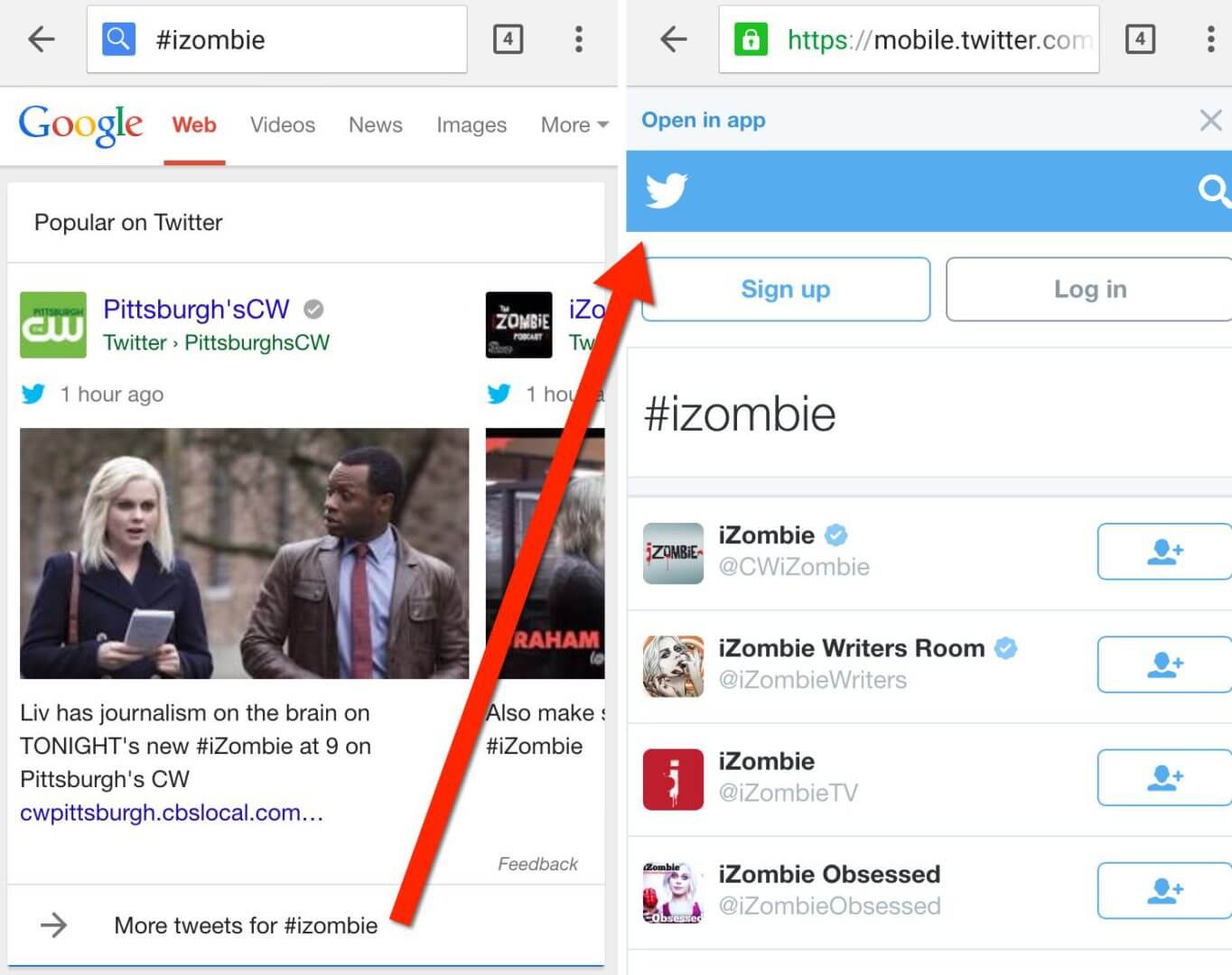
    Both Twitter and Google shared the news in blog posts today, with examples. Below, here’s our own example of how it looks for a search on #iZombie. There’s a “carousel” of tweets at the top of the page, where many of them show large images:
    izombie
    You can slide through the carousel to see other tweets, as shown below:
    tweets in google

    When, Where & Why Tweets Appear Uncertain

    Tweets don’t always appear at the top of the page. Sometimes they might be elsewhere, such as the middle of the page, as this example for “MacBook Pro” shows:
    macbook tweets on google
    Sometimes, tweets might not appear at all. We asked Google about why tweets might show, what controls exactly where they show, if they’re showing all tweets for a query in chronological order or filtering in some way such as to block obscenity or to surface more popular tweets. The company wouldn’t answer any of those questions.
    Google’s blog post on the deal does say:
    It’s a great way to get real-time info when something is happening. And it’s another way for organizations and people on Twitter to reach a global audience at the most relevant moments.
    So presumably, you’re more likely to see tweets in Google when a hashtag, topic, person or organization appears to be trending or is newsworthy.
    For Twitter, Traffic
    Twitter tells us that there’s no direct monetization involved. IE, no clicks on tweets at Google will earn Twitter any direct money. So what’s Twitter getting out of this, assuming it’s not being paid a large licensing fee from Google? Traffic.
    For example, as shown below, clicking on the “More Tweets” link associated with the new Twitter carousel at Google will launch Twitter on someone’s browser, where they can get see more tweets, see ads from Twitter and be encouraged to download the app or sign-up:
    google to twitter
    If you do have the app installed, and you’ve set it to handle links from Twitter, then that launches right into the Twitter app experience:
    google tweets into app

    When Twitter accounts are listed, those are also links that lead back to Twitter, as with this example for Taylor Swift:
    google twitter taylor swift

    Clicking on individual tweets also will launch Twitter from Google’s results.
    It’s important to note that this is NOT tweets coming into Google for the first time, or the first time since the last formal deal ended. Tweets have continued to be in Google since that last deal. The new deal just allows for more of the and with deeper integration. Our past post explains more about this: FAQ: How Twitter’s New Deal To Bring Tweets To Google Search Works.

    Mobile For Now, Desktop Promised

    Right now, the new implementation will only be offered for those searching in the US, in English, using either their browser in iOS or Android or the Google Search App. Twitter promises support for desktop and other languages in the coming months.
    For even more examples of how the new integration is working, see our companion story, 14 Examples Of The New Tweets Showing Up In Google Search.

    Monday, 18 May 2015

    Google “Phantom” Update Rolling Out Targeting Informational, ‘How-To’ Content

    google-76517_640

    NBC reports that an undisclosed, “phantom” algorithm update is rolling out in Google search right now which is primarily impacting publishers of “how-to” style content.
    HubPages, a collection of more than 870,000 miniblogs containing informational content about wide varieties of topics, saw its Google search traffic drop 22 percent from one week to another on May 3.
    Websites like eHow, WikiHow, and Answers.com are other sites that have seen significant drops in traffic over the past couple of weeks.
    Glenn Gabe, of New Jersey-based G-Squared Interactive, is the one to coin the phrase “Phantom” update because this update came without warning, and Google has yet to acknowledge its existence.
    Through analyzing the data, Gabe has determined that this udpdate is not related to Panda or Penguin. However, similar types of “thin” content targeted by Panda are also being targeted by this update.
    Gabe points out that clickbait articles, sites with an abundance supplementary information, pages of stacked videos, and pages difficult to navigate have all lost visibility in recent weeks.
    This update is said to be “ruthless” in its approach — apparently having no problem punishing entire domains for a few instances of thin content.
    “When you have a domain-level algorithm update or ranking change, it can impact the whole site… Pages that should be drawing well could also be pulled down in the results.”
    Google has not formally commented on this update, although at SMX Sydney this week Gary Illyes, from Google’s Webmaster Trends team, alluded to there being a recent change that’s part of a core algorithm update.
    With Google’s Knowledge Graph being notorious for detracting traffic from sites for “how to” searches, coupled with this “Phantom” update, being a content publisher is more challenging than ever. Even Gabe, who analyzes search data for a living, admits to not being able to predict what business will look like tomorrow, next week, next month, etc.
    Have you noticed a significant change in your traffic since the beginning of May? If so, what types of content do you believe was targeted? Details are scarce at this point, so any information we can get is valued.

    Source: http://www.searchenginejournal.com/google-phantom-update-rolling-out-targeting-informational-how-to-content/132812/

    Bing to Roll Out Its Own Mobile-Friendly Algorithm Update

    Today, Bing published details about a future update that promises to improve how it delivers mobile-friendly search results to mobile searchers. Bing’s approach is not unlike Google’s, although there are some subtle differences.
    smartphone-569076_1280
    The key difference here is that Google gave a firm date as to when its mobile-friendly update would be rolled out, while Bing has opted to be a bit more vague. Bing has not given an exact date, other than to say it will be launched in the next few months.
    Another difference is how Bing promises to maintain a balance between mobile-friendliness and relevance. Google’s mobile search results now exclude any page that’s not mobile-friendly, which may not necessarily be the case with Bing’s new algorithm.
    Bing says that non-mobile-friendly web pages may still be included in mobile search results if the content contained within is determined to be the most relevant to the user’s query.
    “While the changes will improve ranking for mobile-friendly pages, webpages that are highly relevant to the given query that are not yet mobile-friendly will not get penalized. This is a fine balance and getting it right took a few iterations, but we believe we are now close.”
    This is intriguing, and I look forward to seeing in practice how well this works out from a user’s standpoint. Will users care how relevant a page is to their query if it’s not formatted to fit nicely on their screen? I suppose we’ll learn more when this eventually rolls out.

    Bing’s Criteria For Determining Mobile-Friendliness

    Bing detailed its criteria for ranking mobile friendly web pages. In addition, the company will soon be releasing a tool for testing whether or not your site meets Bing’s criteria.
    • Navigation – The menus, buttons and links on the page should be large enough and spaced well apart to aid touch-based navigation.
    • Readability – The text on the page should be readable without requiring zooming and lateral scrolling to access specific content.
    • Scrolling – The content of the web-page should fit within the device width, without the need for horizontal scrolling.
    • Compatibility – The content needs to be compatible with the device. For example, if the page contains a video it must be viewable on mobile devices.
    All of the above factors will need to be in place in order for Bing to consider a website truly mobile-friendly.
    This update will be rolled out “in the coming months”, and Bing says you can expect more details to be revealed leading up to the launch.
    Source: http://goo.gl/obhhfp

    Survey: Consumers Prefer Mobile Browser To Apps For Local Information

    Data reflect competitive disadvantage for SMBs who don't optimize for mobile.


    small-business-generic2-ss-1920

    In the larger context of Google and now Bing’s Mobile Friendly algorithm updates comes a new consumer survey from SEO firm BrightLocal. The data show overall that consumer expectations of mobile sites, even for local business owners, have grown significantly since 2013.
    While local businesses have alternative ways to be found in local search apps and vertical or specialized directory apps, the survey data here argue that consumers want to access local business websites on mobile.
    While all survey data should be taken as merely directional information the following findings from BrightLocal are pretty clear: local businesses with mobile-optimized sites (that include the right information) will have a significant advantage over those that are not optimized.
    chart-3
    chart-7
    Perhaps the most interesting finding in the survey of 900 US consumers is the idea that more people are using a mobile browser than apps or maps to find local business information. Accordingly these respondents expressed a greater inclination to contact local businesses with optimized sites — as one might expect.
    The list of most important or desired local business information mirrors findings from earlier surveys by Google and others. Consumers want phone numbers, physical address and hours information to contact or visit these storefronts and locations.
    chart-4
    By the same token, bad local site experiences or missing local business information will turn users away, according to these data.
    chart-5
    Multiple surveys reflect a kind of consensus about the contact and other business information (NAP + hours) consumers are seeking via mobile search. I’m less persuaded by the idea that consumers always want a local business website when they search. Indeed much of the data they’re seeking is available in structured results at the top of Google.
    Generally speaking mobile apps provide a much better experience and environment for local-business information than a browser (e.g., travel or restaurant lookups). I suspect, had the survey questions been more specific and investigated particular use cases, this would have come out. Nonetheless the browser preference is a striking finding and worth investigating with other surveys to see if it holds up.
    Finally, it almost goes without saying that “browser” in this context is a stand-in for “Google.”
    Source: http://selnd.com/1cDFxvb