Showing posts with label SEO Current Trends. Show all posts

Thursday, 14 May 2015

Cut The Crap: The Real Reason Delighting Users Is Fundamentally The Only SEO Strategy

Google is a self-serving publicly traded company. Columnist Nate Dame investigates why that makes delighting users and influencing brand preference the only viable cornerstones of SEO.


SEL One Way SEO

SEO has weathered a host of major (and minor) updates and algorithm changes over the years. Best practices have come and gone. It was the best of times, it was the worst of times….
By now, Google has (and I can’t say I’m upset about this) forced most of the shady, black hat SEO practices into dark corners of the web. Why? Because users hate spam, and Google loves users, of course.
More realistically, Google loves ad space revenue.
Google always says its algorithm updates and entire business model are meant to help users first, but there have been some serious doubts that that’s the case.
Last month, the Wall Street Journal provided the public with a copy of half of the 2012 FTC antitrust investigation into Google Inc. Google defended its business model, saying, in part:
Ultimately [the FTC] concluded that no [legal action against Google] was needed on search, display, and ranking. Speculation about consumer or competitor harm turned out to be entirely wrong. On the other issues raised, [Google] quickly made changes as agreed with the FTC.
Still, the motives and strategies behind the business model were largely revealed, and are generally inconsistent with their professed love of the user.
Google is a business with a bottom line, after all, but the investigation raises questions about Google’s specialized search and the tendency to favor its own services. Is it good for the user, or good for Google? When are human raters vs algorithms used, to what end, and how is it really affecting search?
As far as the SEO community is concerned, it means one thing: creating content that delights users is the only strategy we have left.

Breaking Up With The User

PR statements and Google’s own “What we believe” page are quick to praise the user, placing him at the center of all of Google’s efforts.
The FTC’s 2011-2012 investigation of Google, however, dug up plenty of documents that suggest otherwise. One internal document revealed that, despite priority placed on the user experience in word, user experience sometimes takes a back seat to private interests indeed.
Rather than accept raters’ assessment that competitors had high-quality offerings that should remain in search results, Google changed raters’ criteria twice, finally imposing a set of criteria in which competitors’ services were no longer ranked favorably.
Benjamin Edelman, Beyond the FTC Memorandum
Google is a for-profit business, and the bottom line will always be the bottom line.

Breaking Up With SEOs

Developers at Google don’t seem to really lose sleep at night over the concerns of the SEO community, either.
Google may even view SEOs as a hostile force to some extent. We know that algorithm update announcements have always been a ploy to control SEO behavior — simply because there’s no other reason for Google to make them. The giants of search don’t care to help the SEO community, only to bend us to their will.
And for the most part, Google has won. They have been preaching to “create great content” for years and updating algorithms to force the resistors into doing so. As we move deeper into 2015, there is next to nothing left for spammer SEOs to cheat with. Google has won the war.

The Best SEO Is A Great User Experience

The SEO community is largely at the mercy of Google and its algorithms, but Google, in turn, relies on users’ favor. Users are looking for content, which means Google still needs publishers.
If you never want to worry about Google updates again, strive to use your powers of optimization for good. SEO that creates a great user experience (UX) is the only SEO that is not at odds with Google. It’s the only SEO strategy that Google will never create an algorithm to counter.
ux is seo
Google flight pattern compliments of Moz.
UX is the only long-term SEO strategy.

The Best SEO Is Part Of The (Marketing) Whole

But Google isn’t really interested in creating a digital utopia where everybody does their part and everybody gets their share. The cyclical relationship between Google, its users, and publishers, will not stop Google from invading verticals.
Pushing into content creation themselves — in insurance, travel, shopping, medical, etc. — allows Google to keep as much ad revenue as possible.
[W]hat is the real threat if we don’t execute on verticals? (a) loss of traffic from Google.com because folks search elsewhere for some queries; (b) related revenue loss for high spend verticals like travel; (c) missing opty if someone else creates the platform to build verticals; (d) if one of our big competitors builds a constellation of high quality verticals, we are hurt badly.
Bill Brougher, Google Product Manager
Recent invasions should be the final nails in the coffin for the idea that SEO is somehow separate from a brand’s other marketing strategies and teams. Search is still a valuable driving force — most B2B buyers start researching purchases with a general web search — but it has to be part of an overall strategy to build a specialized audience and influence brand preference.
SEO campaigns should be designed with several other marketing functions in mind:
  • Remarketing. Earning one visit from organic search is great, but users are quick to forget. Remarketing brings them back for the second and third time, resulting in increased brand preference.
  • Gated content. This is critical not only for lead generation, but for audience growth. Email is the still the best channel for content marketing. 77% of consumersprefer to receive promotional messages through email, which means you need those addresses to provide great content the way they want to receive it.
  • Social media. Social is, in many ways, the glue that pulls channels together. After deciding they like your brand, many users search for and follow your Twitter account by default. In fact, the top three reasons given for following brands on Twitter are that they like the brand (55%), to be notified of special offers (51%), and to stay up-to-date with brand news (51%).
It’s time to move beyond static keywords, traffic graphs, and rankings as the end goal. Building a proprietary brand audience, and collecting a little data about them along the way, will allow your brand to create the specialized, targeted content and engaging social campaigns that users have come to expect.
For now, that great user experience will create the signals that search engines need to boost your site’s ranking, and when Google finally does invade your vertical, your integrated campaign will have already built a strong audience for your brand. Best to get to work now.

UX And The Bottom Line

The user experience is to Google what athletics is to Nike, or happiness is to Coca-Cola — it’s what they want you to think they’re providing while they actually sell you sugary beverages, overpriced shoes, or ad space. And that’s fine.
If anything, it should be an even greater incentive to create content that falls in line, because we know the favor it earns from Google is based on something more solid than altruistic fervor. If it were about the UX for the sake of the user, Google might one day call, “Good enough,” and move on. But as so many bottom lines are involved, we always know where it’s headed.
Delighting users always wins. It works with Google’s long-game for better results now, and it will build a brand audience that will stick with you for the long haul — no matter what Google does.

Tuesday, 12 May 2015

8 Marketing Plan Differentiators That Will Make Your Strategy Pop

How do you help your brand stand out from the crowd? Columnist Sonny Ganguly offers up these tips for developing a marketing plan that shines.


team meeting


As a marketer, I know there can be a lot of pressure to make your business stand out from the competition. Each year the process of creating a marketing plan becomes more difficult as the online and offline marketing channels continue to evolve rapidly. It can be difficult to come up with marketing plan differentiators that will deliver the expected results and have a sustainable impact on your brand.
Whether your business is coming up with a marketing strategy for the long term or just making adjustments midyear, use these marketing plan differentiators to make your strategy pop.

1. Focus On Your Brand’s Story

There are several viable brand strategies that could be considered marketing plan differentiators this year, but storytelling is the most effective and easiest to implement for small businesses. While you may have heard the term “storytelling” thrown around the past few years, non-fiction storytelling can be a great way to grow your brand.
Your brand is distinct from your competition, and the best way to convey that to customers is through storytelling. It’s important to make a personal connection with customers by helping them understand your business, your employees, and other customers so they can understand why you’re the best fit.
Previously storytelling was limited to advertising or in-person experiences, but with the prevalence of blogging and social media, it’s become the go-to strategy to achieve brand awareness.
Whether your brand’s stories are about your employees or are told through the eyes of your customers, those stories must reflect real values held by your business. If the story isn’t genuine, you’ll hurt your brand more than you’ll help it. To see a great example of brand storytelling and how it fits into a larger digital marketing strategy, head over toMicrosoft’s Stories site.

2. Reimagine Your Business Website

Notice how I didn’t use the word “redesign?” Whether you just spent a ton of resources redesigning your website or don’t feel like it’s yet time to start over, reimagining your business site doesn’t require a lot of time or money. Rather, it simply requires strategic thinking.
In an age where websites are beginning to look more and more alike, it may be time to think about how to make yours different. Of this list of marketing plan differentiators, your website is one of the easiest places to drive a big impact on your bottom line.
One of the biggest 2015 trends for Web design is to simplify the look and feel by removing nonessential design elements. You can still create dramatic pages with big images or text, but balance those with a more minimalist approach to the number of elements on your page.
Your website should guide potential customers to the point of conversion, so don’t distract them with too many options. Many websites are opting for single-page sites that scroll, with no background colors or hidden main menus. Airbnb is a great example of a website that has simplified its layout to drive users to search its directory — straight to the point!

3. Increase Personalization To Boost SEO

The concept of personalization is not specific to search engine optimization, but SEO is an area where it can be applied. As search becomes more sophisticated, one of the biggest marketing plan differentiators will be personalization based on geographic and demographic data gathered through behavior.
Though it seems rather complex, a number of platforms offer adaptive content options as part of their product offerings — OptimizelyHubSpot and Unbounce are all examples.
Your website visitors are likely landing on your website based on a number of different needs and keywords, so personalizing the content they see will help keep them on your site and boost Web conversions. The more relevant you can make the page’s content, the better.
You can test headlines, forms, page content, calls-to-action — you name it. Even something as small as pulling in localized elements will help visitors find the information most useful for them. Check out the localized reviews on TripAdvisor for a good starting point.

4. Start Listening To Social Media Chatter

As far as marketing plan differentiators go, social media is nothing new. However, your business should be looking for ways to incorporate social into other business processes.
A natural fit for social media within your business is to incorporate social data into your customer service process.
Are customers having conversations about your brand? Are you responding to them in a timely manner? Social listening helps your business get ahead of the curve and jump into conversations before they become support issues.
Although you receive notifications when your brand is mentioned directly, it’s likely that most conversations about your brand are happening without your knowledge. Investing in a social listening platform will help you identify the keywords you want to monitor so you can be notified immediately when someone’s talking about your brand.
You can also track non-branded keywords to join conversations where there’s an opportunity to gain customers on a given topic. If you don’t have the budget (or volume) for a sophisticated platform like Sprout, services such as Hootsuite and Encore Alertoffer great service out of the gates. (Disclosure: I am an adviser to Encore Alert.)

5. Incorporate More Video

Video is often the forgotten form of content when developing a content marketing strategy. Traditionally, videos were difficult to create, expensive and time-consuming. But advances in modern technology have made video much easier (and often cheaper) to produce.
Adding videos to landing pages can increase conversions by nearly 90 percent, according to data from WebDam. It’s time for your business to embrace video marketing across all channels.
With the U.S. watching 38.2 billion videos in the second quarter of 2014 alone, it’s important to reach your customers the way they’re already engaging with other brands and people.
Use your video content on your website, landing pages, social networks and emails to break up text and keep customers entertained. As a bonus, video content is an excellent tool for storytelling. Nonprofit charity:water is a great example of a brand incorporating video across its marketing channels to tell stories about the organization and its donors.

6. Start Thinking Mobile First

As 2014 was the year Internet usage on mobile devices exceeded Internet usage on desktop, it’s time to start designing and writing for mobile devices first.
Like video, the mobile-first concept can (and should) be applied across your marketing channels; 90 percent of American adults have a cell phone, and 64 percent own a smartphone, so consumers are more mobile than ever before.
The popularity of smartphones and tablets has made it so that consumers no longer think about their content consumption or purchase behavior as online or offline — if they see something they like, they can access it just as easily from a computer or mobile device.
Even if you’re far from implementing responsive design, your business can leverage a mobile-first strategy as a marketing plan differentiator in a number of ways.
Identify all the touch points you have with customers and think through the mobile experience. Make sure your website has mobile templates enabled so that your mobile site displays less text, has larger links and buttons, and displays all yourWweb elements to fit the visitor’s screen size.
Carry these concepts across your email marketing templates, paid search or social ads as well. Remember the “KISS” framework when it comes to mobile: Keep It Short and Simple.

7. Increase The Relevancy Of Your Emails

Email marketing is one of the oldest marketing channels that has continued to thrive as the Internet grows and evolves. Email is so effective, in fact, it’s estimated that by 2016 more than 192 billion emails will be sent per day worldwide.
Your email marketing plan differentiator will be to make your emails more relevant to your customers in order to get their attention in a crowded inbox and get them to engage with your messaging.
If you haven’t already, segment your email list by the data you’ve collected about your customers. At WeddingWire, we know when our engaged couples are getting married and how far along they are in the wedding planning process, so we use this data to inform the content and timing of our emails to make our messages relevant for each recipient.
Since your business may not have that depth of information, you can segment your email list by more easily gathered data like geographic location, business type or behavior. If customers engage with a certain type of article, follow up by sending them more information on that same topic.
You can dramatically improve the effectiveness of your email campaigns (open rates, click-through rates, deliverability, and so on), but it starts by increasing the relevance of your messages.

8. Manage Your Online Reputation

Whether your business is categorized as B2B or B2C, it’s important to manage your online reputation by paying attention to your reviews across the Web. Reviews are integral to our business — with over 2 million reviews within the wedding industry — but they’re equally important for all companies to know what customers are saying about their brand.
As more sites like YelpSiteJabber, and Glassdoor gain popularity, and reviews continue to surface on retail and travel websites, it’s more important than ever to monitor your online reputation.
Get proactive about your online reputation by making feedback requests part of your process. Include links to the popular review sites in your emails, on your website or on your social networks to encourage happy customers to review you. Making it a part of your process will help you consistently collect reviews and feedback, which keeps your reputation up to date with recent reviews.
Don’t be afraid of a negative review — learn from it and fix it when you can, but remember that negative feedback will often lend credibility to your online reviews.
I hope this list has helped provide a frame and strategic direction for your next marketing plan. If you have other marketing plan differentiators to add to my list, leave a comment here or send it to me via Twitter.

Monday, 11 May 2015

5 Easy Google Analytics Tips for Web Publishers

If you’re running a blog or magazine-style website and are having success with it, you have no doubt put in a lot of hard work building an editorial process, publishing articles, and have conducted the necessary hand shaking to build your readership.
Trust us, we know how much hard work it takes to become a successful web publisher. We all started at the same place at one point. However, once you’re a successful plateau of content generation, you may find yourself wanting more… wanting to build a better experience for your users that generates more page views, more engagement, more signups, and of course, more revenue. And, that’s where really understanding Google Analytics comes in to play.
Let’s focus on three specific reporting tips that fit well for web publishers:custom dimensions, segments, and goals. Before we jump into each, let’s take a look at a few things every Google Analytics report consists of: dimension and metrics.
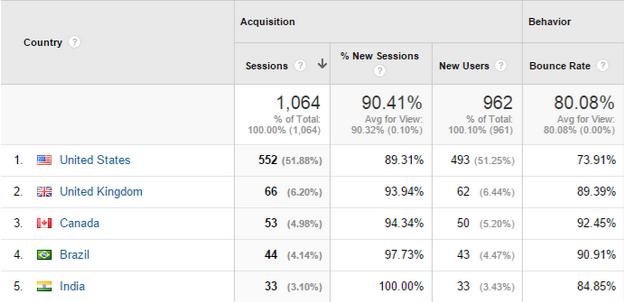
Dimensions – On the left side of your report you will view the report dimensions. Dimensions describe your data. An example of this would be the Location report (found under “Audience”). The location information you see on your left (country in this screenshot) is the dimension of the report.
Untitled document - Google Docs
Metrics – On the right side of the reports, you’ll see the metrics – quantitative measurements of your data. In the screenshot above you can see the acquisition and behavior metrics that correlate with each location dimension.

Custom Dimensions

Now that we have the basics covered, let’s jump into some of the more advanced things we can do with Google Analytics account that will give us a better understanding of how users interact with our website and content.
Now, by default Google Analytics gives us a ton of different dimensions. But, because every website is different, with varied content and users, it’s important to get specific with the kinds of reporting to make right choices for our content. This is where custom dimensions come into play – they allow the web publishers full control to generate reports that feature just about any kind of information or data set that you can think of regarding user data. A few examples of custom dimensions for web publishers are:
  • Article category: Which of your article categories is the most popular?
  • Article tags:  Which tags are your users clicking on the most?
  • Author: Who is the top author of your content?
  • Publication year: Is the current year the most popular of a previous year?
  • User login status: How do data points change for logged-in users (if enabled)?
  • Article length: What is the average length of are your most popular articles?
  • Featured image: Do users spend more time on articles with a featured image?
  • Video: How does your audience respond to posts with videos included?
Once you decide which custom dimensions best describe your content and audience, you can use those specific dimensions to learn more about readers wants/needs. Using some of the examples above, you can find out information about say, your readers’ favorite article category. Now, you may be spending all of your time crafting all of your content about “category A”, but then find out after setting up a custom dimension that “category B” is getting all the attention. Armed with this information you can now adapt to your user’s interests and create content for the preferred topic.
Another example could be content that features video. Maybe you’re not happy with the user engagement data you’re seeing in your analytics overview – time on site is short and bounce rate is high. For some reason you can’t seem to keep your users around long enough. Then you create a custom dimension that looks at your video content, and notice that compared to your overall data, time on site is way up and that bounce rate goes down. You can now make a decision on how to include more video content and create a richer experience for your users.
In order to get started with custom dimensions, you must first make sure your account has been upgraded to Universal Analytics – chances are if you’ve set this up in the last few years it already is, but an older Google Analytics installation might have to go through the upgrade process. You won’t be able to view any custom dimension data until you actually define them – Google Analytics will only track that data from the initial date of setup. You can only define a total of 20 custom dimensions in the free version of Google Analytics so choose them wisely.
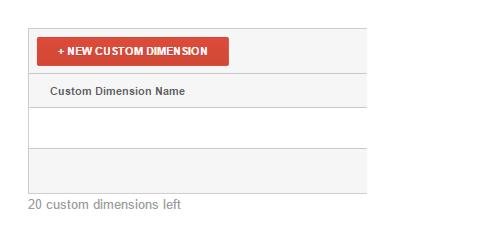
Creating a custom dimension is a fairly painless two-step process.  The first step is accessing the custom dimensions tab in the admin section of your Google Analytics account; go to admin and then access the “custom definitions” drop down in the center column (labeled “properties”):
Untitled document - Google Docs (3)
Next, you will create your first custom dimension:
Untitled document - Google Docs (4)
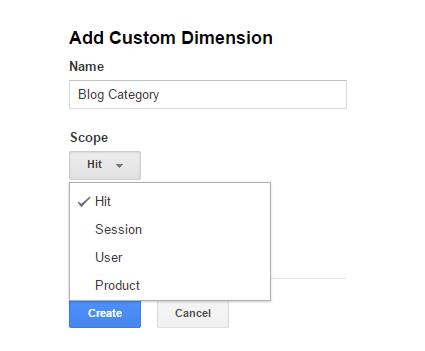
Then, you will define the type of dimension you are looking to track:
Untitled document - Google Docs (5)
The last step will require you to update your Google Analytics code to track the specific data properly. If you’re not the primary developer for your website, you’ll need to reach out to your web developer to make sure the code is properly installed. If you’re a WordPress user using, for example the popular Google Analytics plugin by Yoast, if you upgrade to premium version of the plugin you’ll be able to track custom dimensions without touching a line of code.

Segments

Next, let’s jump into segments, a tool that helps us understand our content and users. Segments are nothing more than subsets of our data and they can be applied to any Google Analytics report easily.
Let’s look at a hands-on example to explain importance of segments.
no-segments
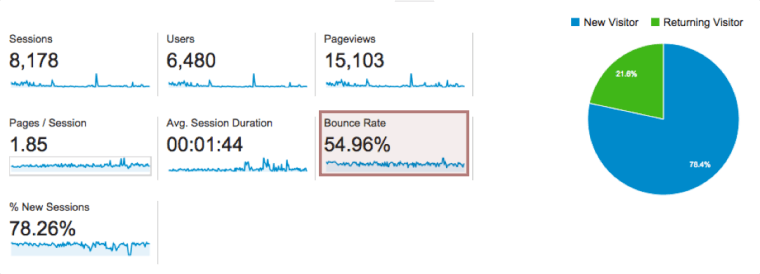
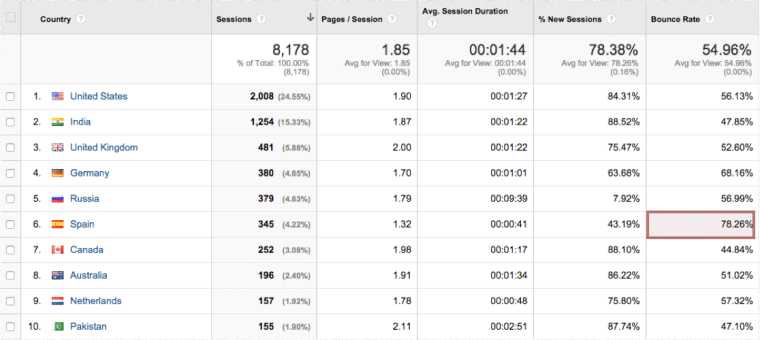
Looking at this report, we can tell that bounce rate is 54.96%. Does this mean estimating likelihood next user to visit our site will bounce at just under 55% is the best we can do? Absolutely not. And, that’s where segments come to the rescue.
Digging deeper into our sample website data, trying to figure out why bounce rate wasn’t lower got me to audience geo-report that simply lists our top countries, ranked by number of sessions.
audience-location
You see how bounce rate for one country REALLY stands out? For some reason Spanish people hate this website. Perfect time to create our first segment. Read about the “how to’s” of building segments here. For this example, all you need to know is that segment represents a subset of traffic that’s coming from Spain.
Once you have created a segment or picked one of the built-in segments, you can apply it to your reports and see a subset of data from all reports associated with that particular segment.
spain-segment
Applying the “Spain” segment allowed me to discover something interesting. The screenshot above is from Exit Pages report (since I was looking into bounce rate) and it helps me see which pages Spanish audience is leaving my site from. Unusually high percentage of people from Spain, compared to site average, leaves my blog page. I know there’s nothing offensive to Spanish audience there, but I also happened to run across a report that says of all EU countries, Spain has lowest percentage of people able to hold a conversation in English.
That is a clue. It tells me I could probably try translating a few posts to Spanish to see if that reduces bounce rate for this particular segment, which will in turn decrease overall bounce rate. Then I can focus on another segment… and another… and another. So, instead of trying to break a bundle of sticks all at once, segments let you break them one by one. Aesop and segments for the win.

Goals

While custom dimensions and segments are extremely important in helping you gain some wonderful insight into how your user base interacts with yourcontent, unless you’re tracking goals conversions, how can you tell if your business is succeeding or failing?
Let’s take a look at the 4 types of goals you can create in your analytics account, but before we do, keep this in mind, a Google Analytics will only start tracking goal conversions after you have defined your goals. You can’t create a goal and see how many people would’ve converted on it in January 2012.

Destination Goals

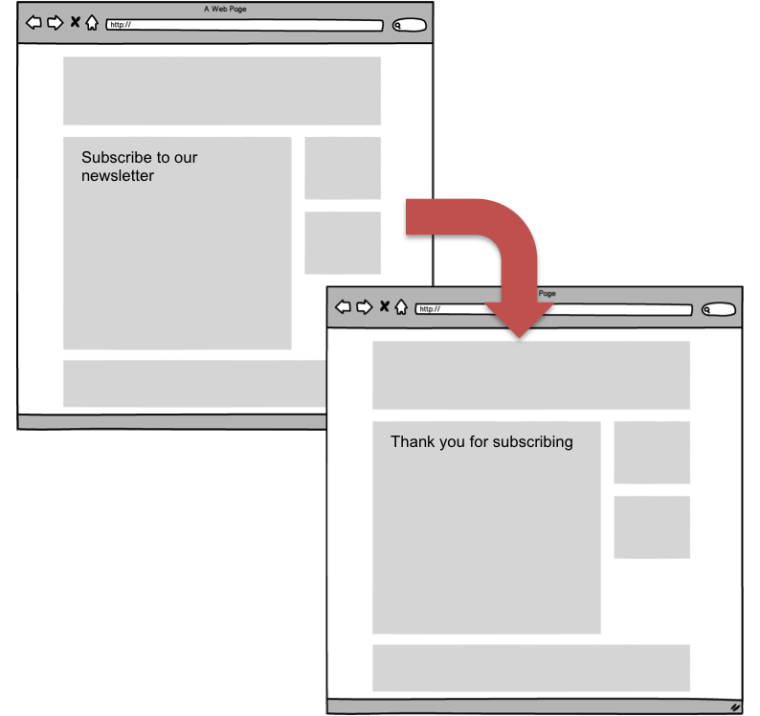
Destination goal is triggered when a user visits a certain page, or multiple pages in specified order. A great destination goal example would be user visiting your “sign up for our newsletter” page, followed by that same user visiting “thank you for subscribing” page after they’ve clicked confirmation link in an email.
destination-goals

Duration Goals and Pages Per Session Goals

These two goal types are similar in sense that they both track engagement, they just do it in different ways. A duration goal will convert every time a user session lasts longer than time you specified, pages per session goal will convert whenever a session consists of “X” pages or more, “X” being number you specified when creating the goal.
They’re both easy to set up and very important for web publishers, so they are a great way for you to familiarize yourself with Google Analytics goals.

Event Goals

Finally, event-type goals are triggered when user complete an action or multiple actions you defined. These can be many different interaction with your site, but a great way to think about them is, for example, wanting to track specific clicks on an advertisement. How valuable would that information be to sponsor? Using this example you would use a line of Google Analytics code to tell analytics to trigger these clicks as an event, then set up an event goal to create the reports. Then you could track different ad placements to see how they perform against each other. Other examples of event goal tracking include goals that don’t have destination pages – download links or ajax buttons that complete a goal without sending the user to an additional web page.
event-goals

Bonus: Goals & Segments

Remember those built-in segments I mentioned earlier? Three of those are goal conversion segments and they help isolate users who convert and sessions in which conversions occurred:
  • Converters
  • Non converters
  • Sessions with conversion
By applying these to your reports you will be able to tell what it is that makes users convert. Perhaps a certain acquisition channel converts far better than others? Are there some landing pages that help conversions? Getting answers to these questions is easy if you apply one of these segments.

In Summary

If you’ve made it this far, you’re ready to jump into your analytics and start answering some of the questions you no doubt have bouncing around your head.
  • What categories of content are my users most interested in?
  • Which one of my guest authors is crushing it?
  • Do people prefer posts with videos in them?
  • Does anyone download that free PDF I spent months working on?
The list will be different for everyone, but they’re all great questions to ask.
Remember, use custom definitions to describe your content better than Google Analytics does it out of the box. Create user segments to better understand your users, and most importantly track goal conversions to know if your website fulfills its target objectives.
This process will help bring your website goals closer to your actual business goals, and you’ll develop more ability to change and adapt at a pace that will have a huge impact on revenue.


Source: http://www.searchenginejournal.com/simple-google-analytics-tips-for-web-publishers/129069/

Friday, 8 May 2015

Google My Business to Link to Third-Party Delivery Services

Local search will now link to delivery services for qualifying businesses in Google Search and Google Maps results. 
google-my-business-seamless-local-search
The new Google My Business feature, which can be activated through the Google My Business dashboard, aims to make reservations, take-away, and delivery easier for consumers by linking to third-party services, like Seamless.com, in search results. Google is also looking to broaden the links to third-party services it includes. The company's support site currently invites service providers for local businesses to fill out a form for inclusion in the program. 
Right now, the links only appear for "eligible businesses," and local businesses cannot request access to the program. 

How to Create Boring-Industry Content that Gets Shared

If you think creating content for boring industries is tough, try creating content for an expensive product that'll be sold in a so-called boring industry. Such was the problem faced by Mike Jackson, head of sales for a large Denver-based company that was debuting a line of new high-end products for the fishing industry in 2009.
After years of pestering the executives of his traditional, non-flashy company to create a line of products that could be sold to anglers looking to buy premium items, he finally had his wish: a product so expensive only a small percentage of anglers could afford them.
dog bored by content
(image source)
What looked like being boxed into a corner was actually part of the plan.
When asked how he could ever put his neck on the line for a product he'd find tough to sell and even tougher to market, he revealed his brilliant plan.
"I don't need to sell one million of [these products] a year," he said. "All I need to do is sell a few hundred thousand, which won't be hard. And as far as marketing, that's easy: I'm ignoring the folks who'll buy the items. I'm targeting professional anglers, the folks the buyers are influenced by. If the pros, the influencers, talk about and use the products, people will buy them."
Such was my first introduction to how it's often wise to ignore who'll buy the product in favor of marketing to those who'll help you market and sell the product.
These influencers are a sweet spot in product marketing and they are largely ignored by many brands
Looking at content for boring industries all wrong
  • They lack clarity on who they are creating content for (e.g., content strategy, personas)
  • There are no specific goals (e.g., traffic, links, conversions, etc.) assigned regarding the content, so measuring its effectiveness is impossible
  • They're stuck in neutral thinking viral content is the only option, while ignoring the value of content amplification (e.g., PR/outreach)
Develop a link earning mindset
Setting the right goals
  1. Increased traffic on the website - He's noticed that when traffic increases, so does his business.
  1. More phone calls - If they get a customer on the phone, the chances of closing the sale are around 75%.
  1. One blog per week on the site - The more often he blogs, the more web traffic, visits and phone calls increase.
  1. Links from some of the businesses in the area - He's no dummy. He knows the importance of links, which are that much better when they come from a large company that could send him business.
  1. Develop relationships with small and midsize non-competing businesses in the area for cross promotions, events and the like.
Know the audience
  • 21-35 years old
  • Drives a truck that's less than fours years old
  • Has an income of $45,000-$59,000
  • Employed by a corporation with greater than 500 employees
  • Active on social media, especially Facebook and Twitter
  • Consumes most of their information online
  • Typically referred by a friend or a co-worker
PR and outreach: Your amplification engines
  • Who/what influences his core audience?
  • What could he offer them by way of content to earn their help?
  • What content would they find valuable enough to share and link to?
  • What challenges do they face that he could help them with?
  • How could his brand set itself apart from any other business looking for help from these potential outreach partners?
Putting it all together
Content is only as boring as your outlook
The untold truth about creating content for boring industries
  1. There are no boring brands. Those two words are a cop out. No matter what industry you serve, there are hoards of people who use the products or services who are quite smitten.
  1. What they see as boring, I see as an opportunity.
big content example2: Two pieces of evergreen content (goal: traffic)
1: A link-worthy asset (goal: links)
Create a winning trifecta: Outreach, promotion and amplification
2: "Can Hail Damage Cause Structural Damage to Your Car?" and "Should You Buy a Car Damaged by Hail?"
1: "Big as Hail!" contest
Summary
A few months back, I received a message in Google Plus that really piqued my interest: "What's the best way to create content for my boring business? Just kidding. No one will read it, nor share information from a painter anyway."
I went from being dismayed to disheartened. Dismayed because the business owner hadn't yet found a way to connect with his prospects through meaningful content. Disheartened because he seemed to have given up trying.
You can successfully create content for boring industries. Doing so requires nothing out of the ordinary from what you'd normally do to create content for any industry. That's the good news.
The bad news: Creating successful content for boring industries requires you think beyond content and SEO, focusing heavily on content strategy and outreach.
Successfully creating content for boring industries—or any industry, for that matter—comes down to who'll share it and who'll link to it, not who'll read it, a point nicely summed up in this tweet:
So when businesses struggle with creating content for their respective industries, the culprits are typically easy to find:
Alone, these three elements are bad; taken together, though, they spell doom for your brand.
content does not equal amplification
If you lack clarity on who you're creating content for, the best you can hope for is that sometimes you'll create and share information members of your audience find useful, but you likely won't be able to reach or engage them with the needed frequency to make content marketing successful.
Goals, or lack thereof, are the real bugaboo of content creation. The problem is even worse for boring industries, where the pressure is on to deliver a content vehicle that meets the threshold of interest to simply gain attention, much less, earn engagement.
For all the hype about viral content, it's dismaying that so few marketers aren't being honest on the topic: it's typically hard to create, impossible to predict and typically has very, very little connection to conversions for most businesses.
What I've found is that businesses, regardless of category, struggle to create worthwhile content, leading me to believe there is no boring industry content, only content that's boring.
"Whenever we label content as 'boring,' we're really admitting we have no idea how to approach marketing something," says Builtvisible's Richard Baxter.
Now that we know what the impediments are to producing content for any industry, including boring industries, it's time to tackle the solution.
There are lots of article on the web regarding how to create content for boring industries, some of which have appeared on this very blog.
But, to my mind, the one issue they all suffer from is they all focus on what content should be created, not (a) what content is worthy of promotion, (b) how to identify those who could help with promotion, and (c) how to earn links from boring industry content. (Remember, much of the content that's read is never shared; much of what's shared is never read in its entirety; and some of the most linked-to content is neither heavily shared nor heavily read.)
This is why content creators in boring industries should scrap their notions of having the most-read and most-shared content, shifting their focus to creating content that can earn links in addition to generating traffic and social signals to the site.
After all, links and conversions are the main priorities for most businesses sharing content online, including so-called local businesses.
ranking factors survey results
(Image courtesy of the 2014 Moz Local Search Ranking Factors Survey)
If you're ready to create link-earning, traffic-generating content for your boring-industry business follow the tips from the fictitious example of RZ's Auto Repair, a Dallas, Texas, automobile shop.
With the Dallas-Forth Worth market being large and competitive, RZ's has narrowed their speciality to storm repair, mainly hail damage, which is huge in the area. Even with the narrowed focus, however, they still have stiff competition from the major players in the vertical, including MAACO.
What the brand does have in its favor, however, is a solid website and a strong freelance copywriter to help produce content.
Remember, those three problems we mentioned above—lack of goals, lack of clarity and lack of focus on amplification—we'll now put them to good use to drive our main objectives of traffic, links and conversions.
For RZ, this is easy: He needs sales, business (e.g., qualified leads and conversions), but he knows he must be patient since using paid media is not in the cards.
Therefore, he sits down with his partner, and they come up with what seems like the top five workable, important goals:
marketing group discussing personas
(image source)
Too many businesses create cute blogs that might generate traffic but do nothing for sales. RZ isn't falling for this trap. He's all about identifying the audience who's likely to do business with him.
Luckily, his secretary is a meticulous record keeper, allowing him to build a reasonable profile of his target persona based on past clients.
This information will prove invaluable as he goes about creating content. Most important, these nuggets create a clearer picture of how he should go about looking for people and/or businesses to amplify his content.
Armed with his goals and the knowledge of his audience, RZ can now focus on outreach for amplification, thinking along the lines of...
Being the savvy businessperson he is, RZ pulls his small staff together and they put their thinking caps on.
Late spring through early fall is prime hail storm season in Dallas. The season accounts for 80 percent of his yearly business. (The other 20% is fender benders.) Also, they realize, many of the storms happen in the late afternoon/early evening, when people are on their way home from work and are stuck in traffic, or when they duck into the grocery store or hit the gym after work.
What's more, says one of the staffers, often a huge group of clients will come at once, owing to having been parked in the same lot when a storm hits.
Eureka!
lightbulb
(image source)
That's when RZ bolts out of his chair with the idea that could put his business on the map: Let's create content for businesses getting a high volume of after-work traffic—sit-down restaurants, gyms, grocery stores, etc.
The businesses would be offering something of value to their customers, who'll learn about precautions to take in the event of a hail storm, and RZ would have willing amplifiers for his content.
First—and this is a fatal mistake too many content creators make—RZ visits the handful of local businesses he'd like to partner with. The key here, however, is he smartly makes them aware that he's done his homework and is eager to help their patrons while making them aware of his service.
This is an integral part of outreach: there must be a clear benefit to the would-be benefactor.
After RZ learns that several of the businesses are amenable to sharing his business's helpful information, he takes the next step and asks what form the content should take. For now, all he can get them to promote is a glossy one-sheeter, "How To Protect Your Vehicle Against Extensive Hail Damage," that the biggest gym in the area will promote via a small display at the check-in in return for a 10% coupon for customers.
Three of the five others he talked to also agreed to promote the one-sheeter, though each said they'd be willing to promote other content investments provided they added value for their customers.
When business owners reach out to me about putting together a content strategy for their boring brand, I make two things clear from the start:
In almost every case, they want to discuss some of another big content piece that's sure to draw eyes, engagement, and that maybe even leads to a few links. Sure, I say, if you have tons of money to spend.
(Amazing piece of interactive content created by BuiltVisible)
Assuming you don't have money to burn, and you want a plan you can replicate easily over time, try what I call the 1-2-1 approach for monthly blog content:
1: A strong piece of local content (goal: organic reach, topical relevance, local SEO) 
This plan is not very hard at all to pull off, provided you have your ear to the street in the local market; have done your keyword research, identifying several long-tail keywords you have the ability to rank for; and you're willing to continue with outreach.
What it does is allow the brand to create content with enough frequency to attain significance with the search engines, while also developing the habit of sharing, promoting and amplifying content as well. For example, all of the posts would be shared on Twitter, Google Plus, and Facebook. (Don't sleep on paid promotion via Facebook.)
Also, for the link-worthy asset, there would be outreach in advance of its creation, then amplification, and continued promotion from the company and those who've agreed to support the content.
To RZ's credit, he didn't dawdle, getting right to work creating worthwhile content via the 1-2-1 method:
1: "The Worst Places in Dallas to be When a Hail Storm Hits"
This contest idea came from the owner of a large local gym. RZ's will give $500 to the local homeowner who sends in the largest piece of hail, as judged by Facebook fans, during the season. In return, the gym will promote the contest at its multiple locations, link to the content promotion page on RZ's website, and share images of its fans holding large pieces of hail via social media.
What does the gym get in return: A catchy slogan (e.g., it's similar to "big as hell," popular gym parlance) to market around during the hail season.
It's a win-win for everyone involved, especially RZ.
He gets a link, but most important he realizes how to create content to nail each one of his goals. You can do the same. All it takes is a change in mindset. Away from content creation. Toward outreach, promote and amplify.
While the story of RZ's entirely fictional, it is based on techniques I've used with other small and midsize businesses. The keys, I've found, are to get away from thinking about your industry/brand as being boring, even if it is, and marshal the resources to find the audience who'll benefit from from your content and, most important, identify the influencers who'll promote and amplify it.
What are your thoughts?