Two more changes are coming to Google mobile search results, the search engine
announced last week — this time to the way URLs are displayed.
- Mobile search results no longer show the actual page URL, but instead show a breadcrumbs-like format of the URL structure. This is rolling out worldwide.
- The breadcrumbs-like information can show the site name in place of the domain name. This is rolling out in the U.S. only for now.
These before and after examples from Google’s announcement post on the Google Webmaster Central blog show what’s changing:
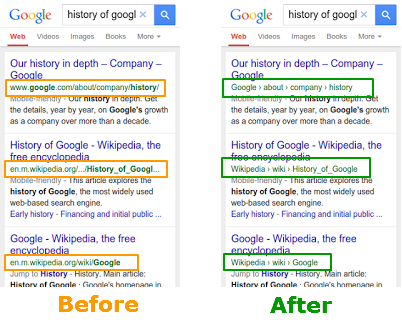
URL structure replaced by breadcrumb format in Google mobile search results
The change replaces a SERP result’s URL with a description of the page’s location in a “breadcrumbs-like format.” The exciting part of this announcement for online marketers is that
you can control your displayed breadcrumb URLs and site name using Schema.org structured data. Google’s Gary Illyes gave an
enthusiastic explanation:

Google Webmaster Trends Analyst Gary Illyes shares the news.
Change #1: Breadcrumbs Format instead of URL Structure
Google now displays the breadcrumbs-like format instead of URLs in mobile search results, period. The search engine has been testing this formatting for years in web and mobile search, and they’ve decided to implement it worldwide for mobile searches. Therefore, whether your site has marked up its pages with structured data or not, Google shows a breadcrumb format in place of your URL structure.
You can
specifically control how the breadcrumb URL appears if you add Schema.org markup to the HTML on your pages. Refer to Schema.org’s
breadcrumbs structured data for details; you can also find
instructions in Google Developers Help, although at the time of this writing, the page was not up-to-date:

A Google Developers reference for Breadcrumb structured data markup can be found here: https://developers.google.com/structured-data/breadcrumbs.
But what if you don’t (yet) have
schema markup on your site?
Without structured URL data to refer to, Google will display whatever structure it feels best represents the way that page fits in your site.Google primarily bases this on:
- Actual page URL, and/or
- Breadcrumb navigation on the page
Well Structured URLs for the Win
Google looks for clues starting with the page URL itself. If you have organized your website content in a physical silo structure, with folders arranged in a logical way, then you have a big advantage. Even your naked URLs reveal a lot of information. As a best practice, the directories leading to your page should communicate a clear idea of what your page is about, both to the search engines who crawl your URL path and to visitors who see the URL in their browser address bar.
For example, compare the well-structured URL (top) to the flat directory structure below it:
- com/engine-parts/cooling/audi-a6-quattro-engine-timing-belt-kit.html
- com/cooling-audi-a6-quattro-engine-timing-belt-kit.html
Notice how, in the first URL, the folders “engine-parts” and “cooling” provide context for the name of this product page. We know that this product falls within the category of engine parts used for cooling.
A well-structured URL doesn’t have to be many levels deep to communicate what a page is all about. In fact, keeping pages within a few clicks of the home page is a recommended SEO best practice (three to five clicks deep is a good maximum guideline, though very large sites may need more). Flattening your URLs so that everything is on one level, as in the second URL above, creates chaos. There are many reasons to have
structured URLs versus a flat directory structure, and Google’s latest announcement adds another reason to the list.
Breadcrumb Navigation Leads to SEO Success
Does your site have breadcrumb navigation links at the top of each page? Those little links help search engines understand your site structure in a powerful way. Breadcrumb links pass link equity within your site to reinforce your
silo strategy. Showing a logical breadcrumb path on every page of your site naturally passes link juice up to your main landing pages. It also has a user-friendly benefit, since people can click there to find their way up to broader levels of content.
Now there’s another benefit to implementing breadcrumb navigation, and that’s to give Google a suggested format for a breadcrumb-structured URL.
Note: In cases where a page’s breadcrumbs do not match its structured URL, and there’s no schema markup to follow, we aren’t sure whether the breadcrumbs or URL would take precedence. Knowing Google, we believe the URL algorithm would make a judgment call influenced by the page content and possibly the user’s query. If anyone has real-life examples that shed light on this, please comment below.
Change #2: Site Name instead of Domain
The second part of Google’s announcement was that the new structured URLs could show “the real-world name of the site instead of the domain name.” This change only applies to mobile searches in the U.S. for now, but is likely to be distributed more widely.
Google’s own help topic for
including your site name in search resultssays
you can provide one or more names for your website using Schema.org markup on your official home page. If you provide more than one possible name, Google’s algorithm will choose between them for each result. However, specifying just one site name lets you control what is displayed at the beginning of your structured URL breadcrumbs in Google mobile search results. In the examples Google gave, “www.wikipedia.com” and “www.google.com” were simplified:

A site name can be specified with structured markup.
Why Specify Your Site Name in New Breadcrumb URLs
The best reason to mark up your site name is for branding. You want people to recognize your business by name, and Google’s giving you another opportunity to be seen. It’s also a cleaner look — if you start your breadcrumbs-style URL with the business name, it allows more space for users to read the words that come next.
It’s easy to see that this shortened breadcrumb URL format will give major brands an advantage. Searchers can see a familiar and trustworthy name more clearly now that it’s not hidden between other characters, and as a result, recognizable brands may see their click-through rates on mobile improve.
Be sure to specify a true and natural name of your business, not anything deceptive. Interestingly, the comments on Google’s announcement post contained many predictions that spammers would take this and run with it. In other words, a small shoe manufacturer might specify the site name “Nike” and try to appear bigger than they are.
According to Google’s
guidelines for specifying your site name, the website name (or names) you supply in your markup should meet certain criteria. Your site name must:
- Be reasonably similar to your domain name
- Be a natural name used to refer to the site, such as “Google,” rather than “Google, Inc.”
- Be unique to your site — not used by some other site
- Not be a misleading description of your site
Google can smell spam a mile away. Don’t be foolish enough to even try deceiving the search engines, or your site rankings will suffer. Instead, follow the guidelines, implement structured breadcrumb URLs your way, specify your site name, and take advantage of opportunities as they appear.


