Wednesday, 25 February 2015

Best Way To Write A Title Tag For Better Search Engine Optimization

What makes you read an article at once? What is that driving force that makes you feel that an article might be interesting? The answer to these questions is the title of an article. The title of a page is the most important constituent of an article which tells the search engine about the content of your page.

In order to increase the traffic on your page, that is to increase the number of visitors on your page, you need to have an effective title tagline for SEO and you also need to have an interesting title for the readers.
For example, if you Google “how to write a resume” the first and the top most search result will be the exact match of your search. The title for this article was molded in such a way that it appears at the top in the search list.   However when you go through the search results, you find 2nd and 3rd article titleds “How To Write A Resume, Resume Writing, Sample Resume” and “How to Make a Resume (with Free Sample Resumes)” respectively. Although the top result was taken by the exact match of our search, but this article even more click worthy since it includes words like “Free Sample Resumes“.
how to write a resume
Screenshot – april 10, 2013 (Google.com)
Note : By seeing the above picture you may argue that the first article has more chances of attracting the visitors because there is Google plus author profile linked to it, despite being simple compared with 2nd and 3rd search result. But my point here is only to compare the titles and see how effective is 2nd and 3rd results without considering the Google profile pic.
In the above example you can see the 2nd result – “How To Write A Resume, Resume Writing, Sample …. ” and if you want to see the complete title, just open the site in any browser and keep the cursor over the tab and you can see the see the complete title like the picture below:
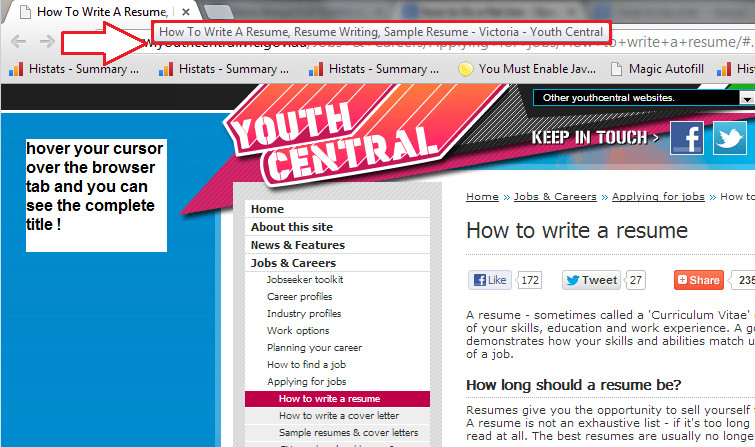
browser cursor
The above mentioned example surely suggests on how you need to design your title, which not only appears among the top search results but also has an eye catching and interesting title to force the visitors to click on it.
Before jumping onto any conclusion regarding the process of making a title interesting and make it appear at the top of the search list, it is necessary to know a few details.

Meta Tags

These are XHTML elements that are used to deliver any information about the website’s page to the users of the website and search engines. These elements include
  • Title tag lines
  • Description
  • Keywords

Know about title tags

These are the part of Meta tags, which are present around the top most part in the HTML covered under the <head> area. Similar to the titles of the chapters that you have in a book, these title tags tells the search engines and the readers about the content of your page. It is the title tag of your page which will make the persons searching on the search engines to make a decision whether they must look into your page or not.
Not only this, title tag must contain some of the keywords which will enable search engines to understand what your page is all about. The title tags must be designed in such a way that they should appear catchy for the human eyes and should also be formatted according to the needs of search engines.
You must always remember that it is the title tag is the most important tag which tells the search engine about the content of your page. It is also equally important for your SEO strategy.
Here are some of the ways in which you may end up giving a good title to your page which will surely boost the traffic on your site.

Write a Reader Friendly Title

In the previous example we have already seen that the search result that came on top of the result was left behind by the one which was amongst the tops and also had an effective and interesting title added to its page. The title “10 east steps to make a cake” when referred to one’s website, does not sound as ambiguous as it appears to be in a search result.
Whenever you are writing a title tag for your page, there are bound to be several questions in your mind. Here, we try to answer the most important ones.
  • What are the norms about the length of the title tag?
The length of the article must not exceed 70 characters. Secondly, you should invest adequate thought in the placement of keywords.
At this point, you could ask – what if you are writing a language that goes from right to left? Or, what if your target audience is from a country having these language norms? Well, in these cases, you have to reverse the order.
  • How shall I go about the construction of the title tag in terms of placement of words?
The important and more descriptive of the keywords must come in the initial parts of the title tag, and the less important ones must be kept for the latter parts.
  • What if I need to use similar important words?
In such cases, you may use pipes in order to distinct important phrases. You must also see to it that you do not have any commas, exclamation mark, underscores or other punctuations in your tag.
  • Is using the name of my company in the title tag advisable?
Use the name of the company in the title tag only when the name forms a portion of your tag. Most of the SEO‘s advice to either leave them out or to place them at the last of you title tag.


Tuesday, 24 February 2015

The Top 7 SEO Trends Dominating 2014


Google has been busy over the past year, and traditional SEO strategies, tasks and roles have changed considerably.


Let’s take a look at what we’re seeing thus far in 2014.

1.    Google Authorship is rising in importance


More business owners are realizing the importance of Google Authorship and are taking Author Rank more seriously; as they should, particularly since Google has confirmed they do use a form of Author Rank – at least in terms of ranking in-depth articles.

The end of 2013 saw Google reducing authorship snippets by 15% in an effort to increase clickthroughs to only the highest quality content. This has meant an overall reduction in the total number of search results being accompanied by authorship info, and increased competition among authors.

We’re also seeing a tiered system in terms of what’s displayed next to search results: some search results are displayed with full authorship details, while others are displayed with only a byline.

Factors that continue to determine whether authorship snippets are included (or what tier is used) include the reputation and trustworthiness of authors, as well as the website on which the content is published.


There has been speculation that those who don’t establish some degree of authority via Author rank will become irrelevant (i.e. their content will no longer rank). While we’re not there yet, it’s a strong reminder for writers and marketers to get Authorship set up now before we do reach that point. For help with that, see “Google Authorship: How to Dress Up Your Search Results to Demand Attention.”

 2.    Brands are realizing the necessity of social media, as it plays a major role in website traffic referrals and content dissemination


So far in 2014, social media seems to be a major factor (if not the major factor) in terms of referral traffic and content dissemination.

According to recent research released by Shareaholic, Facebook continues to lead the pack in terms of social media referral traffic. In March 2013, Facebook drove 21.25% of all traffic sites receive. Pinterest came in 2nd at just over 7% of all traffic, although its share of traffic has grown by 48% since December. Twitter continues to trail behind with a 1% share of all website traffic.

With many sites struggling to earn even mediocre rankings in the search engines, brands are increasingly seeing social media as a quicker way to get their content in front of their target market, and to increase website traffic.

3.    “Content marketing” is beginning to replace the term “SEO”


Most experts would agree that it’s no longer enough to simply have an SEO strategy. In fact, I’ve noticed the term ‘content marketing’ starting to become used synonymously with ‘SEO’. While the two should certainly be differentiated on many levels, many argue that content marketing is the ‘new SEO’.

Business owners and marketers should continue to focus on creating high-quality content guided by solid keyword research based on SEO competition and keyword research, with a focus on topical and long-tail targeting. But the days of picking a handful of keywords and putting all efforts toward becoming ranked #1 for those keywords are over. Competition is simply too high in all industries now; there’s always going to be at least one other brand doing it better and spending a higher budget than you.

A solid content marketing strategy aims to build your exposure for many long-tail keywords while also building brand awareness, authority, credibility, social media awareness, and conversion rates. It’s a “cast the net” approach rather than a “throw the spear” approach.

However, any content marketing strategy should employ SEO best practices at its foundation; meaning following important on-page SEO elements that are still relevant and useful in 2014, and will remain useful through 2015 and beyond. A technical knowledge of SEO coupled with a corresponding strategic content marketing plan is the online marketer’s new secret weapon.

4.    Guest blogging has been redefined


Guest blogging was probably the biggest buzzword throughout 2013. SEO professionals and online marketers preached the value of this tactic for building links, brand authority, credibility, and myriad other benefits. For many marketers, that was all turned upside down when, in his January webmaster video and blog post, Matt Cutts made the startling and controversial pronouncement: “Stick a fork in it: guest blogging is done.”

In response to misinterpretations of his statement, however, he scaled his announcement back by differentiating ‘good’ guest blogging from bad. In short, ‘bad’ guest blogging means doing so solely as a means of getting links; ‘good’ guest blogging means contributing excellent content to build your audience and reputation.


He writes: “There are still many good reasons to do some guest blogging (exposure, branding, increased reach, community, etc.). Those reasons existed way before Google and they’ll continue into the future.”


Guest blogging will continue to remain an excellent strategy for building your audience, your brand and your personal thought leadership plan. And yes, those inbound links will still count. However, spammy, low-quality guest blogging is a thing of the past, and smart marketers will focus instead on using guest blogging for the many other benefits it provides. For my response to the guest blogging debate, see my article, “Guest Blogging Dead? Not Even Close.”

 5.    SEO is becoming more expensive as it becomes more difficult to get inbound links and create link-worthy content
 

Pre-Panda, producing content that would rank highly was relatively easy. Slap up some keyword-rich content, get a few keyword-rich links to it, and you were good to go.

But as ranking well becomes more difficult, marketers and business owners are realizing the need to increase their investment in content creation and link building in order to rank in the search engines.

Roles like Content Manager, Director of Content, and Content Marketing Officer (CMO) are becoming increasingly mainstream, as is the outsourcing of content creation and link building. I predicted the rise of this responsibility in a June 2013 post titled “The Job Title That You’ll Need to Hire by the End of 2013.” According to recent research by Kapost, 54.1% of marketers are prioritizing content marketing team hiring above any other sub-discipline.

This hefty investment in content creation and SEO is meaning brands are having to carefully re-evaluate the types of content they’re producing, and actively track whether that content is helping them achieve their goals.

6.    In-house SEOs are becoming coordinators for actual fulfillment work


With the increased volume of tasks and the wider range of skills needed for content creation and SEO, in-houses SEO professionals are increasingly being called on to coordinate the fulfillment of work, based on their technical knowledge, rather than completing it themselves.

While in the past, SEOs would typically write and optimize content and build relationships with other site owners for link building purposes, these roles are now being outsourced to agencies who have built existing relationships with high-quality publishers and blogs. SEO professionals themselves are becoming project managers, coordinating responsibilities, assigning them, and assessing and repairing on-site optimization problems.

An in-house SEO in 2014 is far more likely to be found making decisions, finding contractors and overseeing content strategies and link building, rather than doing it themselves.


7.    As competition for online visibility rises across all industries, the demand for SEO services is increasing


With the vast majority of businesses now actively using content marketing as part of their overall marketing strategy (some research puts this number as high as 94% for B2B small businesses), the competition for search engine rankings is fiercer than ever.

And because of this increase in competition, SEOs – both in-house and agencies – are being called on to get all this expensive content ranking well in search engines.

Despite the obvious rise in the popularity of content marketing, the 2014 Moz Industry Survey shows that a greater number of marketing professionals are being tasked with SEO (78%) than are responsible for content marketing (49%).


So to those who say that SEO is dead, I would say ‘not by a long shot’. The tasks and roles associated with SEO may have changed and SEO may be steadily integrating with content marketing, but I don’t see SEO going anywhere anytime soon.

We’ve seen many changes this year when it comes to SEO, but one thing is certain: despite the changes, businesses continue to experience its value in terms of building their reputation, increasing their visibility and getting traffic to their site.

What would you add to this list? What other SEO trends are dominating so far in 2014?


Source: For more details visit: The Top 7 SEO TrendsDominating 2014

Friday, 20 February 2015

High PR Ping Submission Site List


Ping Submission Site List

Google Page Rank


blogsearch.google.com 7
pingomatic.com 7
twingly.com/ping 7
auto-ping.com 6
bitacoras.com 6
blo.gs/ping.php 6
icerocket.com 6
icerocket.com 6
mypagerank.net 6
bitacoras.com 5
blogpingtool.com 5
feedshark.brainbliss.com 5
pingler.com 5
ping.amagle.com 4
ping.in 4
pingmyblog.com 4
rpc.weblogs.com 4
totalping.com 4
weblogs.com 4
blogbuzzer.com 3
bulkping.com 3
feedburner.google.com/fb/a/ping 3
googleping.com 3
backlinkping.com 2
blogs.yandex.ru 2
pingbomb.com 2
ping-fast.com 2
pingoat.net 2
pingfarm.com 2
ezedir.com 1
pingates.com 1
pingsitemap.com 1
syncr.com 1

Top Blog Directories To Submit Your Blogs

This summary is not available. Please click here to view the post.

Thursday, 19 February 2015

120+ Free High PR Blog Submission Sites

It's always good to a blogger to submit their blog to lots of web directories, because alone doing normal won't only get you traffic, but also you need to get you genuine and fresh backlinks, you'll also get ranked higher by this approach. So, make it your blog get valuable backlinks using free blog submission sites to progress your blog growth. Below is the list of free blog submission sites.


S.No DIRECTORY NAME PR SUBMIT URL TYPE
1   wordpress.com 9 Submit Free
2   wikipedia.org 9 Submit Free
3   blogger.com 9 Submit Free
4   xing.com 9 Submit Free
5   tumblr.com 8 Submit Free
6   weebly.com 8 Submit Free
7   livejournal.com 8 Submit Free
8   jimdo.com 8 Submit Instant Approval
9   merchantcircle.com 8 Submit Free
10   sfgate.com 8 Submit Free
11   wix.com 8 Submit Free
12   academia.edu 8 Submit Free
13   last.fm 8 Submit Free
14   reddit.com 8 Submit Free
15   commons.wikimedia.org 8 Submit Free
16   wikispaces.com 7 Submit Free
17   webs.com 7 Submit Free
18   bravenet.com 7 Submit Free
19   zoho.com 7 Submit Free
20   intuit.com 7 Submit Free
21   angelfire.lycos.com 7 Submit Free
22   rhizome.org 7 Submit Free
23   blog.fc2.com 7 Submit Free
24   couchsurfing.org 7 Submit Free
25   diigo.com 7 Submit Free
26   newsvine.com 7 Submit Free
27   rediff.com 7 Submit Free
28   evernote.com 7 Submit Free
29   edublogs.org 7 Submit Free
30   yola.com 7 Submit Free
31   quora.com 7 Submit Free
32   tripod.lycos.com 7 Submit Free
33   wikidot.com 7 Submit Free
34   squarespace.com 7 Submit Free
35   ehow.com 6 Submit Free
36   hubpages.com 6 Submit Free
37   blog.com 6 Submit Free
38   ucoz.com 6 Submit Free
39   dailystrength.org 6 Submit Free
40   shutterfly.com 6 Submit Free
41   care2.com 6 Submit Free
42   skyrock.com 6 Submit Free
43   sitew.com 6 Submit Free
44   migente.com 6 Submit Free
45   wayn.com 6 Submit Free
46   moonfruit.com 6 Submit Free
47   livestrong.com 6 Submit Free
48   virb.com 6 Submit Free
49   over-blog.com 6 Submit Free
50   friendster.com 6 Submit Free
51   areavoices.com 6 Submit Free
52   redbubble.com 6 Submit Free
53   kinja.com 6 Submit Instant Approval
54   blogtoplist.com 6 Submit Free
55   devhub.com 5 Submit Free
56   soup.io 5 Submit Free
57   own-free-website.com 5 Submit Free
58   myanimelist.net 5 Submit Free
59   webgarden.com 5 Submit Free
60   dinstudio.com 5 Submit Free
61   jigsy.com 5 Submit Free
62   mouthshut.com 5 Submit Free
63   sciencestage.com 5 Submit Free
64   jambase.com 5 Submit Free
65   cookeatshare.com 5 Submit Free
66   sosblogs.com 5 Submit Free
67   hazblog.com 5 Submit Free
68   snappages.com 5 Submit Free
69   webspawner.com 5 Submit Free
70   doomby.com 5 Submit Free
71   blogbaker.com 5 Submit Free
72   beep.com 5 Submit Free
73   justpaste.it 5 Submit Free
74   spruz.com 5 Submit Free
75   fotki.com 5 Submit Free
76   blogflux.com 5 Submit Free
77   pen.io 5 Submit Free
78   kickofflabs.com 5 Submit Free
79   buzzerhut.com 5 Submit Free
80   bloggernity.com 5 Submit Free
81   ourstory.com 4 Submit Free
82   hasenchat.net 4 Submit Free
83   yousaytoo.com 4 Submit Free
84   hpage.com 4 Submit Free
85   mywapblog.com 4 Submit Free
86   iconosites.com 4 Submit Free
87   massidea.org 4 Submit Free
88   modwedding.com 4 Submit Free
89   geckogo.com 4 Submit Free
90   freewebsite-service.com 4 Submit Free
91   wallinside.com 4 Submit Free
92   lintas.me 4 Submit Free
93   bcz.com 4 Submit Free
94   manifo.com 4 Submit Free
95   getjealous.com 4 Submit Free
96   jukeboxalive.com 4 Submit Free
97   workitmom.com 4 Submit Free
98   jux.com 4 Submit Free
99   all-blogs.net 4 Submit Free
100   blogratings.com 4 Submit Free
101   purevolume.com 3 Submit Free
102   socialmediatoday.com 3 Submit Free
103   lifeyo.com 3 Submit Free
104   gamerdna.com 3 Submit Free
105   bugs3.com 3 Submit Free
106   all4webs.com 3 Submit Free
107   rollr.com 3 Submit Free
108   blogcatalog.com 3 Submit Free
109   blog-search.info 3 Submit Free
110   blogratedirectory.com 3 Submit Free
111   bloggingsmostwanted.com 3 Submit Free
112   goodnightjournal.com 2 Submit Free
113   blogtopsites.com 2 Submit Free
114   dailyroads.com 2 Submit Free
115   axj.com 2 Submit Free
116   indimusic.tv 2 Submit Free
117   astromindsclub.com 2 Submit Free
118   forumforyou.net 2 Submit Free
119   bizeso.com 2 Submit Free
120   volunteeralliance.org 2 Submit Free
121   wrttn.in 2 Submit Free
122   wannafollow.me 2 Submit Free


If you found any new good Free Blog Submission Sites please comment, i will add them in the list.