Friday, 8 May 2015

7 Digital Marketing Skills Every Professional Needs

7 Digital Marketing Skills You Need to Succeed


1. The Online Hustle

If there’s one thing that internet marketers are masterful at, it’s the online hustle. And by that I mean, the ability to jump online, identify key influencers or companies, figure out how to contact them and then be persistent as hell about getting what you want. This skillset is critical in everything from finding a job to getting guest blogs to nabbing new clients.
Every professional today needs to be a digital ninja, adept at tracking down opportunities online and coming up with creative ways to turn those opportunities into reality. Maybe that means Tweeting at the hiring manager of your dream job or doing some light online stalking of a new business partner you want to impress. Regardless of your goal, you’d do well to learn how to become an expert at leveraging the web to get what you want. 

2. E-Relationships

In the digital age, your first point of contact with anyone new is almost always done online. So it’s absolutely crucial that you hone your interpersonal e-mailing skills. You might be thinking, “Uh, I’m pretty sure I know how to e-mail,” but just because you can type and press send doesn’t mean you’re doing a bang-up job at using e-communication to your advantage.
When it comes to forming and maintaining excellent professional relationships online, it’s all about finesse. Digital marketers are pros at becoming BFFs with people they’ve never even met in person. Sometimes that means making a cheesy joke about the weather or asking an authentic question about the recipient’s life, but the point is to go the extra step to turn your faceless e-mail address into a real, living, breathing human with whom people want to work.

3. Social Media Savvy 

The only person who can acceptably say things like, “Oh, I just don’t get social media” is your grandmother…and even she’s probably posting funny pictures on Facebook. Social media know-how may have once been a bonus, but it decidedly necessary by now.
Regardless of the field you’re in, you should have a polished LinkedIn profile at a minimum, but you should also have a decent working knowledge of Facebook, Twitter, Google+, Pinterest, Instagram and Tumblr. Anything less makes you come across as a bit of a dinosaur in the professional world. This is especially true if, like many, you’re working in the start-up world, where every employee is a jack of many trades and should be ready to take the helm of the company’s Twitter account or Pinterest boards if asked to do so.

4. Finger on the Pulse 

In the digital marketing field, it’s essential to keep up with trending topics, modifications to the Google search algorithm and new social media policies, just to mention a few things. As the game is always changing, it’s stay current or perish. And while things might not move at such a breakneck pace in other industries, keeping abreast of news and trends in your niche is pretty much always a surefire way to get ahead.

5. Data Matters

Internet marketers are not just about crafting cool messages and viral social media posts. Hard data is actually where the rubber hits the road, because no amount of hard work or clever words matter unless they’re having an impact on the goal of increasing exposure and opportunity. All professionals would do well to become more data-oriented if they want to be more successful. After all, the work only works if it has your intended result.

6. SEO 101

It’s not really necessary for all of us to be SEO experts. But as internet users and professionals, we should all have a basic grasp on how websites earn a high ranking position in Google searches. Here are a few key understandings:
  • How to spot an ad versus an organic result in search results.
  • The fact that websites that are in the top organic results of Google searches are there because they’ve established themselves as a legitimate and reliable, over time.
  • Google punishes websites that use cheap shortcuts to try to rank quickly.
  • The more reputable websites that link to a website, the higher its ranking.
  • The more people share links to a site on social media, the better it does in rankings.
  • New businesses need to work hard to establish themselves online – no one will find your new website if you don’t put in serious work to build a presence.
  • For content to boost SEO, it needs to use popular search key terms naturally.
  • One easy and reliable way to climb the rankings is to consistently add original content to your site in the form of blog posts. 

7. In Your Audience’s Shoes 

The digital marketer’s perennial question is: Who is my audience? In this world, that may be the customer or the potential client. Even if that’s not true for your field, you have an audience. When you tweak your resume or put together a presentation for colleagues or just write a new blog, you’ll improve your work in a serious way if you make every move with your audience in mind. Marketers know that their opinion is sort of irrelevant in the sense that they can be over the moon about a new idea, but if it won’t resonate with the audience, it’s worthless.
As the internet becomes an increasingly dominant part of business, all professionals have a duty to become proficient in basic digital marketing skills.
And when you add this skillset to your already impressive qualifications in your field, you become a double threat and infinitely more valuable to current and future employers.

Monday, 27 April 2015

Mobile Search Spend Share to Reach 83% by 2018

Just before Christmas, research from eMarketer predicted that by 2018, mobile will account for 76.7 percent of search spend. But the market research firm has since come up with an even more staggering number for mobile's share by 2018: 83 percent.
The December prediction was lower than one from June, as a result of major companies having unpredictably high ad revenues. Not even Facebook saw its great end to 2014 coming, which resulted in other marketers moving their advertising dollars from paid search to mobile display ads for that quarter. So eMarketer's most recent predicted figure jumping back up so much in just two months fits in with the industry's overall rapid shift toward mobile.
Back in 2012, desktop accounted for 87 percent of marketers' search budgets, while only $2.24 billion (12.9 percent) went toward mobile. These figures include contextual text links, paid inclusion, paid listings, and SEO, while mobile accounts for advertising on search engines, search applications, and carrier portals for both smartphones and tablets.
Mobile's spend share has since increased at a steady rate, climbing 12 percent in 2013 and 15 percent in 2014. This year, another expected 13 percent increase will bring the total amount marketers will spend on mobile search up to $12.97 billion.
Related articles
As mobile has grown, desktop search spend has decreased just as quickly. In two short years, desktop spend has dropped $1.5 billion, losing 27 percent of the spend share. For 2015, eMarketer predicted desktop search will be $12.3 billion. With 47.4 percent of the share, desktop will be less than mobile for the first time.
 
emarketer-mobile-graph


"It's not surprising. I also don't think the trend is surprising to big players like Google, either," says Cathy Boyle, a senior mobile analyst at eMarketer. "The writing's been on the wall for a while now as consumers are getting more and more comfortable doing everything with their mobile devices."
Boyle sees mobile continuing to grow beyond that, but is unable to venture a guess as to how much.
"There's still a lot of desktop use in office spaces so it's hard to predict where the ceiling is," she says.
Also back in June, eMarketer looked at the mobile search ad revenues for different companies. The research firm found that while Google will still have the overwhelming majority of the search share, the search giant's growth is tapering. In December, the research firm revisited these numbers and while it still expects that Google's share will be just more than 61 percent by 2016, Yelp and YP will have slightly bigger pieces of the pie than previously reported.
 
emarketer-mobile-graph2

What's mostly responsible for Google's decline is the "other" category. Other's share declined 5 percentage points from June to December, though that's because Yahoo is no longer lumped in that category.
The main threat to Google seems to be apps. Boyle explains that's because people tend to search in verticals - looking at both Kayak and TripAdvisor for travel deals, say - on desktop, whereas on mobile devices, those searches typically happen in-app.
"[Search is] just a lot more niche within an app, which has very specific targeted searching," she says. "It's a parallel behavior, just executed in a different way."


Google’s New Mobile Breadcrumb URLs

Google’s New Mobile Breadcrumb URLs: Making the Most of Your Site Name & URL Structure


Two more changes are coming to Google mobile search results, the search engine announced last week — this time to the way URLs are displayed.
  • Mobile search results no longer show the actual page URL, but instead show a breadcrumbs-like format of the URL structure. This is rolling out worldwide.
  • The breadcrumbs-like information can show the site name in place of the domain name. This is rolling out in the U.S. only for now.
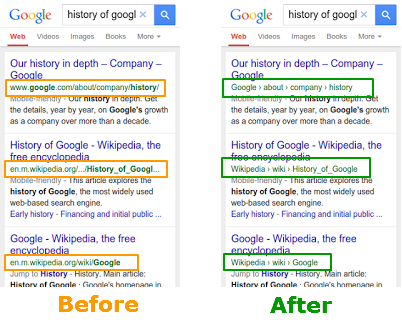
These before and after examples from Google’s announcement post on the Google Webmaster Central blog show what’s changing:
breadcrumb-url-example
URL structure replaced by breadcrumb format in Google mobile search results
The change replaces a SERP result’s URL with a description of the page’s location in a “breadcrumbs-like format.” The exciting part of this announcement for online marketers is that you can control your displayed breadcrumb URLs and site name using Schema.org structured data. Google’s Gary Illyes gave an enthusiastic explanation:
gary-illyes-mobile-url
Google Webmaster Trends Analyst Gary Illyes shares the news.

Change #1: Breadcrumbs Format instead of URL Structure

Google now displays the breadcrumbs-like format instead of URLs in mobile search results, period. The search engine has been testing this formatting for years in web and mobile search, and they’ve decided to implement it worldwide for mobile searches. Therefore, whether your site has marked up its pages with structured data or not, Google shows a breadcrumb format in place of your URL structure.
You can specifically control how the breadcrumb URL appears if you add Schema.org markup to the HTML on your pages. Refer to Schema.org’sbreadcrumbs structured data for details; you can also find instructions in Google Developers Help, although at the time of this writing, the page was not up-to-date:
google-breadcrumb-documentation
A Google Developers reference for Breadcrumb structured data markup can be found here: https://developers.google.com/structured-data/breadcrumbs.
But what if you don’t (yet) have schema markup on your site? Without structured URL data to refer to, Google will display whatever structure it feels best represents the way that page fits in your site.Google primarily bases this on:
  • Actual page URL, and/or
  • Breadcrumb navigation on the page

Well Structured URLs for the Win

Google looks for clues starting with the page URL itself. If you have organized your website content in a physical silo structure, with folders arranged in a logical way, then you have a big advantage. Even your naked URLs reveal a lot of information. As a best practice, the directories leading to your page should communicate a clear idea of what your page is about, both to the search engines who crawl your URL path and to visitors who see the URL in their browser address bar.
For example, compare the well-structured URL (top) to the flat directory structure below it:
  • com/engine-parts/cooling/audi-a6-quattro-engine-timing-belt-kit.html
  • com/cooling-audi-a6-quattro-engine-timing-belt-kit.html
Notice how, in the first URL, the folders “engine-parts” and “cooling” provide context for the name of this product page. We know that this product falls within the category of engine parts used for cooling.
A well-structured URL doesn’t have to be many levels deep to communicate what a page is all about. In fact, keeping pages within a few clicks of the home page is a recommended SEO best practice (three to five clicks deep is a good maximum guideline, though very large sites may need more). Flattening your URLs so that everything is on one level, as in the second URL above, creates chaos. There are many reasons to havestructured URLs versus a flat directory structure, and Google’s latest announcement adds another reason to the list.

Breadcrumb Navigation Leads to SEO Success

Does your site have breadcrumb navigation links at the top of each page? Those little links help search engines understand your site structure in a powerful way. Breadcrumb links pass link equity within your site to reinforce your silo strategy. Showing a logical breadcrumb path on every page of your site naturally passes link juice up to your main landing pages. It also has a user-friendly benefit, since people can click there to find their way up to broader levels of content.
Now there’s another benefit to implementing breadcrumb navigation, and that’s to give Google a suggested format for a breadcrumb-structured URL.
Note: In cases where a page’s breadcrumbs do not match its structured URL, and there’s no schema markup to follow, we aren’t sure whether the breadcrumbs or URL would take precedence. Knowing Google, we believe the URL algorithm would make a judgment call influenced by the page content and possibly the user’s query. If anyone has real-life examples that shed light on this, please comment below.

Change #2: Site Name instead of Domain

The second part of Google’s announcement was that the new structured URLs could show “the real-world name of the site instead of the domain name.” This change only applies to mobile searches in the U.S. for now, but is likely to be distributed more widely.
Google’s own help topic for including your site name in search resultssays you can provide one or more names for your website using Schema.org markup on your official home page. If you provide more than one possible name, Google’s algorithm will choose between them for each result. However, specifying just one site name lets you control what is displayed at the beginning of your structured URL breadcrumbs in Google mobile search results. In the examples Google gave, “www.wikipedia.com” and “www.google.com” were simplified:
site-name-breadcrumb
A site name can be specified with structured markup.

Why Specify Your Site Name in New Breadcrumb URLs

The best reason to mark up your site name is for branding. You want people to recognize your business by name, and Google’s giving you another opportunity to be seen. It’s also a cleaner look — if you start your breadcrumbs-style URL with the business name, it allows more space for users to read the words that come next.
It’s easy to see that this shortened breadcrumb URL format will give major brands an advantage. Searchers can see a familiar and trustworthy name more clearly now that it’s not hidden between other characters, and as a result, recognizable brands may see their click-through rates on mobile improve.
Be sure to specify a true and natural name of your business, not anything deceptive. Interestingly, the comments on Google’s announcement post contained many predictions that spammers would take this and run with it. In other words, a small shoe manufacturer might specify the site name “Nike” and try to appear bigger than they are.
According to Google’s guidelines for specifying your site name, the website name (or names) you supply in your markup should meet certain criteria. Your site name must:
  • Be reasonably similar to your domain name
  • Be a natural name used to refer to the site, such as “Google,” rather than “Google, Inc.”
  • Be unique to your site — not used by some other site
  • Not be a misleading description of your site
Google can smell spam a mile away. Don’t be foolish enough to even try deceiving the search engines, or your site rankings will suffer. Instead, follow the guidelines, implement structured breadcrumb URLs your way, specify your site name, and take advantage of opportunities as they appear.