This month, a lot of mobile commerce sites are being put to the test for the first time. Mcommerce sites are expected to cross the 10% mark in their contribution to online retail sales, and retailers will be collecting usage data to figure out what users like and dislike.
In my own shopping experiences, both through mobile sites and mobile apps, I’m finding a consistent theme running through the product pages I see: retailers are unsure how to handle product descriptions.
It’s a fact of life that mobile screens are small, and I’ve recently looked at how that impacts decisions about
SEO and mobile content.
“Hide-and-seek” Content
Retailers are trying different approaches with respect to the design of their description areas. Some hide them completely, providing a “more info”-type link to keep the clutter to a minimum. Others provide a small sample of the description, while a few brave souls actually include the entire text – sometimes several screens worth.
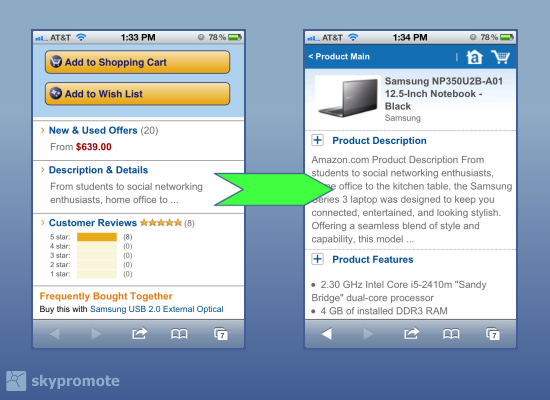
Amazon's mcommerce site provides a very short on-page description, linking to a second page for more details.
While these approaches deal with user interface issues, they’re all trying to fix a fundamental problem: mobile sites are using product descriptions created for desktop sites. And quite often, these descriptions are already second-hand, pulled from offline catalogs, manufacturer databases, or print brochures that promote the product. Sometimes they’re long, sometimes short, but they’re often not optimized for search, or edited to fit the needs of mobile users.
Specific Pitfalls With Mobile SEO
Here are some red flags to look for when evaluating product descriptions for an mcommerce site:
- Descriptions from the manufacturer. You’ll find these copied at all your competitor websites. Google dismisses duplicated content from natural search listings, so you’ll be completely reliant on shopping results as your non-paid channel.
- Marketing lingo. Often a symptom of manufacturer-supplied content. Filled with brand attributes but no descriptive keywords.
- Lists of specs. A common pitfall for B2B, or any technology product.
How To Manage Wholesale Revisions
Once you’ve identified problem areas, you can start to plan what resources you’ll need to make changes. There are lots of ways to manage the workflow for a wholesale upgrade of your product copy:
- In-house staff. Either full-timers or interns. This is the direct approach, and produces consistent results, but it can get expensive.
- User-generated edits. Think Wikipedia, where readers suggest edits to make the description better. This is clever and cheap, but you need a very large audience to get enough activity. Plus, moderation is necessary to keep the quality up.
- Crowdsourcing. My personal favorite. Revising large numbers of products is an ideal project for a team of remote workers, who can log-in on their own time and tackle them a few at a time. Crowdsourcing tools are difficult to master, but once you nail down a process, you can plow through thousands of SKUs in a few weeks, with good quality results and no need for extra staff.
Pick Your Battles
Whatever method you choose, costs are an important consideration. Creating content – even in bite-size chunks – can get expensive. And that cost has to be justified by ROI.
So how do we prioritize a project where there might be thousands of SKUs to look at?

Clockwise from top left: Buy.com is very text-heavy, while Best Buy only has specs. Walmart.com has a good balance of copy and specs.
Let’s start with the highest priority fixes, and work our way down:
- Top sellers. You could sort this by sheer volume of sales, or their contribution to profits – whatever defines business success for your store.
- Word count. The longest descriptions probably good candidates for a “long-story-short” version.
- Lack of category name in the text. This is a good indication that the description lacks keywords. Most mcommerce sites are run from a database, so a script that looks for category names in the text can be quick way to assess this.
- Ratio of numbers to letters. For technical products (especially B2B) a lot of numbers in the description (say, 20%) mean you’re probably looking at a spec sheet.
So now you’ve identified the your mobile commerce site’s issues, chosen a method for manage the workflow, and singled-out the products that need revising. Now you can circle back to the “hide-and-seek” design issue, and adapt your page designs to fit the content.
I’ll get into that in the next column, but if you’d like a sneak preview of the factors we’ll be talking about, have a look at my past article on
using JQuery Mobile for SEO.
Some opinions expressed in this article may be those of a guest author and not necessarily Search Engine Land. Staff authors are listed here.


