Tuesday, 12 May 2015

Link Building Never Ends

Columnist Andrew Dennis discusses how to roll with the ongoing, cyclical nature of link building -- and of digital marketing in general.


link-building-never-ends-andrew-dennis
Link building is a long-term project that never ends, and it is a natural part of the ongoing marketing cycle.
In order to remain relevant to both search engines and human beings alike, you need to regularly acquire fresh links for your website. Fresh links create exposure to new audiences and signal continuing engagement to search engines.
Building links is not a one-time, “set it and forget” type of marketing strategy. Link acquisition is an ongoing investment that helps your business, site, and brand grow over time. You shouldn’t think of link building as a short-term SEO boost; you should view links as part of your continuous marketing cycle.
More than just recognizing the ongoing need for links, it’s important to understand where link acquisition fits within the marketing cycle. Link building as a strategy targets customers at the top of the marketing funnel, but in the order of operations, links come last.

Building Links Comes Last

Seeking links will be the final process after you’ve gone through the proper steps of an online marketing campaign.
In online marketing, there is an order of operations that must be completed appropriately, step-by-step. And there are a number of processes you must implement before you begin to build links.
In a recent article on Inbound.org, my colleague Nicholas Chimonas referred to these processes as the “pre-flight checklist.” Here is a summary of the actions Nicholas covered in his post:
  • Build a user-friendly website
  • Optimize your technical and on-page SEO
  • Ensure your site is not currently being penalized
  • Perform market research
  • Create compelling and valuable content
If you haven’t taken these necessary steps, you’re not ready to start manually pursuing links.
While it is possible to acquire links without first implementing all of the above processes, those links will be ineffective for both marketing and search. Links will help new users find your site — but if your site isn’t ready to be found, all the traffic in the world won’t do any good.
Additionally, you will struggle to build the types of meaningful, quality links you need if you’re not adding value to the web. If you don’t deserve links, you’re going to have a hard time building them, and any links you do get will be questionable at best.
Respecting this order of operations will make matters much easier when you turn your focus to promoting your site.

Marketing Is Cyclical, Not Linear

Successful marketing is cyclical and ongoing.
To have long-term success, you must continuously revisit each part of the greater marketing cycle. For example, let’s look at each portion of the checklist Nicholas laid out.
  • Build a user-friendly website. Sites need to be regularly updated and often need redesigns to meet audience expectations and demands.
  • Optimize your technical and on-page SEO. On-page SEO factors require constant upkeep and ongoing management due to various changes and updates to Google’s algorithm.
  • Ensure your site is not currently being penalized. Keep an eye on traffic drops that could indicate potential penalties.
  • Perform market research. Audience behavior, competition, and market trends all typically change over time.
  • Create compelling and valuable content. Fresh content must be perpetually created, and older content updated.
An effective online marketing strategy will be cyclical, not linear. This means your marketing efforts never end, and this includes manually seeking out link opportunities.

Link Building Never Ends

Link acquisition is part of the greater online marketing cycle, and it’s an ongoing endeavor.
Link building never ends because:
  • The web is constantly evolving, and cyclical marketing will continually generate link prospects.
  • Continued content creation, in particular, will create necessary link opportunities.
  • Link rot (explanation below) requires fresh links.
  • Competitors will continue to improve and build links.
As you revisit other portions of the cycle, you will discover and generate new link opportunities. Through renewed market research, you can discover new audiences and a whole slew of fresh websites to pursue for links.
By adhering to the cyclical nature of online marketing, you will continuously be generating new content assets. As you build new assets, you will also need to promote them to earn audience attention and links. Building links may come last, but if you overlook this final step, you are missing golden opportunities for your new content — great content deserves great promotion (and great links).
Similar to on-page SEO factors, your link profile requires upkeep as well. Due to the nature of the web, “link rot” is a real issue. Many of the links to your website will become broken or dead over time, and you need to replace the lost link equity. If you’re not continuously replenishing your link profile with fresh links, you’re losing overall link equity.
Finally, link building never stops because it doesn’t stop for your competitors. Simply because you decide to stop investing in links doesn’t mean your competition will cease. If you invest in the order of operations properly, you’ll set yourself up to naturally earn some links (ideally) even if you aren’t actively building them; however, so will your competition. Manually pursuing links provides an extra boost beyond passively earning and can set you apart from your competitors.
As mentioned before, there is a sort of natural “link decay” that occurs over time, and if you’re not adding fresh links to your portfolio, you’re moving backward. However, link rot aside, if you stop pursuing links and remain stagnant, you’re still falling behind your competition.
Link building is not a short-term, quick fix. In order to have lasting impact, you must treat link acquisition as a sustained campaign and a stable part of your rotating marketing cycle. Link building never ends because effective marketing never ends.  

Recap

Link acquisition is an ongoing strategy that is contained within a larger marketing cycle.
To successfully earn worthwhile links, you must remember these key points.
Link acquisition comes last. Follow the pre-flight checklist laid out by Nicholas Chimonas before you start actively seeking links.
  • Build a user-friendly website.
  • Optimize your technical and on-page SEO.
  • Ensure your site is not currently being penalized.
  • Perform due diligence with market research.
  • Create compelling and valuable content.
Marketing is cyclical, not linear. Effective marketing is constant and cyclical; you must continuously move through each step of the cycle and repeat.
  • Sites need to be regularly updated and occasional redesigns.
  • On-page SEO requires upkeep and management.
  • Monitor traffic drops and potential penalties.
  • Audience behavior, competition, and market trends all typically change over time.
  • Fresh content must be perpetually created and older content updated.
Link building never ends. Earning links is a long-term strategy that never stops.
  • By revisiting other steps in the cycle, you will discover and generate new link opportunities.
  • Links naturally become broken or dead over time, and you must acquire fresh links to offset lost link equity.
  • Your competition isn’t going to stop pursuing links — so if you do, you will fall behind.
Rather than look for quick fixes or boosts, commit to a sustained and ongoing marketing cycle that works for your business.

Monday, 11 May 2015

Google Testing “Value Alert” Notice In Google Shopping Ads

May indicate a new way of highlighting items on sale in product listing ads.


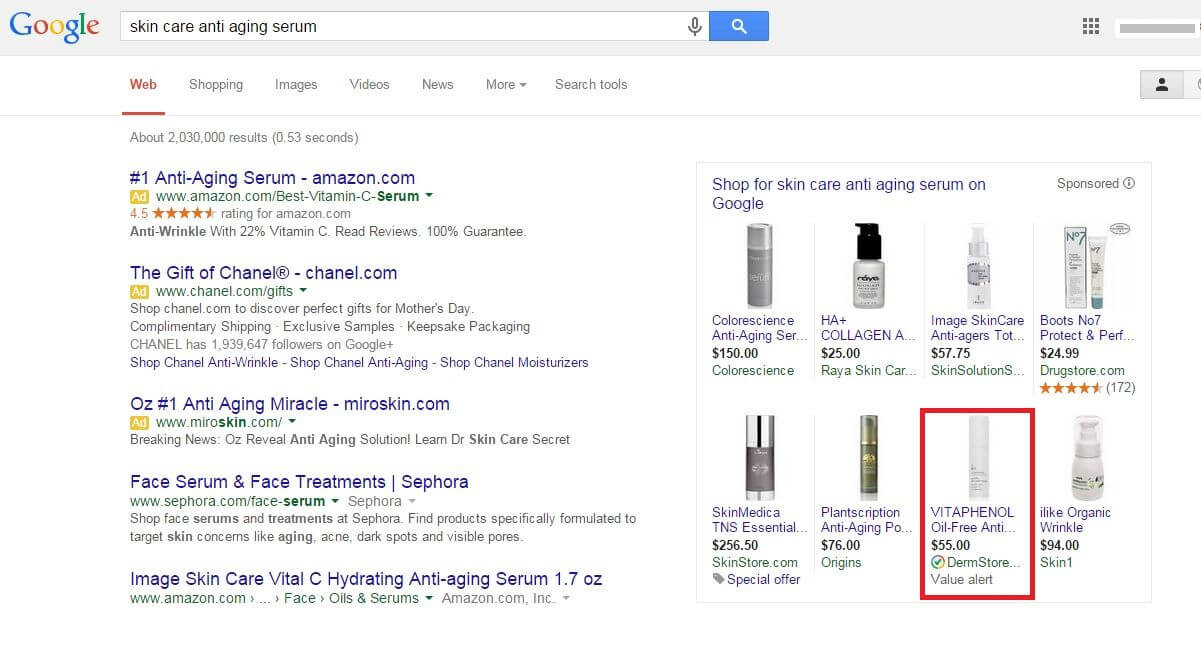
google adwords value alert notice test in google shopping ads
Google has another test running on product listing ads, this time one that highlights “value” products.
Spotted by Elizabeth Marsten at CommerceHub on Thursday, the test displays a “Value alert” message at the bottom of the ad. What’s interesting is that the ad from the DermStore does not have the lowest product price among the ads shown. The ad shown from Raya Skin Care has by far the lowest price at $25.00. Rather it may be that Google is testing a new way of showing items that are on sale or significantly discounted.
A look at the product page on DermStore.com does show sale prices on that brand (there is not a Vitaphenol serum listed on the site, though, and it’s not clear which product is showing in the search results). The “Value alert” message may only trigger based on the size of the discount; the Vitapehenol products on sale are currently discounted by 52 percent. It’s also not clear if the advertisers’ TrustedStores status has anything to do with inclusion in the test.
The experiment does appear to be very limited at this point. I haven’t been able to get it to trigger, and Marsten says she wasn’t able to get it to display again in subsequent searches.
Google declined to offer details when we asked about it, but we’ll update here if we learn anything more.

How To Acquire A New Location & Avoid Screwing Up The Local SEO

Expanding your business by acquiring a new location? Columnist Andrew Shotland discusses how to preserve its existing search equity while rebranding.


new-location-ss-1920
Acquisition of competitor locations is a common growth strategy for multi-location businesses, providing quick entry into a market, economies of scale, etc. Typically, you’ll know exactly how much you can pay for a location — unless, of course, you don’t have good understanding of how easy it is to screw up its local rankings. It’s not uncommon for an acquisition that looks good on paper to look absolutely horrible on Google, often making the price a lot higher than expected.
If you’re going to buy some new locations, you would do well to hand this to-do list over to your deal guys and whomever is managing the digital part of the transition:

1. Get The Old Domain In The Deal & Keep It Live

Goes without saying right? Wrong. I can’t tell you how many times we have been brought in post-acquisition, and the old domain (which is typically the old brand) is 404ing. The seller stopped paying the hosting bill, and the acquirer didn’t even think about it because they were going to use their brand’s domain.
There’s no quicker way to lose organic, referral, social and direct traffic than turning off the old site. At a minimum, you should 301 redirect the old site to your new site, or to the page for the new location on your site.

2. Get Old Corporate Links In The Deal

If the old brand was part of a multi-location company and had a single landing page on the corporate site, then see if your Biz Dev guys can get the seller to agree to 301 redirect the landing page on their site to the new location page on your site.
If you can’t get that, then at least see if you can get them to agree to link from their site to the new location page on your site for at least a few months after the deal closes to keep the link juice flowing during the transition.

3. Get The Old Phone Numbers In The Deal

Consistent NAP (Name, Address, Phone) data is a critical part of local SEO. When you rebrand a local business, you often go through a ranking rollercoaster as Google encounters inconsistent NAPs throughout the Web.
Keeping the phone numbers consistent can help. Also, if the business had print ads displaying phone numbers, those numbers may continue to generate leads for some time that you’ll want to capture.

4. Get Access To The Old Google My Business & Citation Pages In The Deal

It still blows my mind that, in 2015, you can spend a huge amount of money buying a business and not get the login for its Google My Business (GMB) page or its local citation profiles (e.g. Yelp, YP.com, etc.).
When you buy a car, you typically ask for the keys, right? Ask for the GMB and citation keys, too! In writing.

5. Get Access To The Old Google Analytics Data In The Deal

Funny story. A new client calls me up. Can’t get into her Google Analytics (GA) to give us the access we had requested. Turns out a former (disgruntled) employee has the login and wants $60,000 to give her access!
We worked it out with Google, and the blackmailer got bupkis. But come on, people — ask for access to the Google Analytics data… in writing! It’s easy enough to set up a new GA profile, but the historical data might be of interest to you.

6. Do NOT Mark The Old Business’ GMB Page As “Closed” *

For some reason, new owners love to mark the old brand’s Google My Business page as CLOSED. I am thinking there’s a certain perverse satisfaction in erasing the old brand from existence.
Too bad all this does is show that the place you just spent your hard-earned simoleons on is CLOSED. Remember, just because your brand is super-duper catchy doesn’t mean that people won’t still be searching for the old brand — and they’ll probably be searching for a long time.
A better strategy would be to update the old brand’s description to say that it is now known as your brand.

7. Do NOT Mark The Old Business’ Citation Pages As “Closed”

See the previous note, except now do this on every key local search site you can find like Yelp, YP.com, Abumba, etc. Fun work. Might want to use some local listings management tools for this step!

8. Update The NAP At The Main Business Aggregators First

When you update a business’ NAP information at the companies that supply the base set of business listings to many of the major local search services — Acxiom, D&B, Factual, InfoGroup, and Neustar Localeze — it can often take a long time for that data to make it out onto the Web in places Google can find. We tell clients that they should expect to see the results of data aggregator updates in about 90 days; in reality, however, many of the publishers that use this data update it sporadically, so there’s no telling when it will show up.
If you want to be really on top of your game, you may even consider updating the NAP at the aggregators before you rebrand. This could cause a bit of turbulence early on, but should make for a smoother transition once the new brand is launched.

9. Update The Old Business Citation Pages Next

Forgetting about the old brand’s citation profiles on the major local directories is one of the most common mistakes I see in rebranding. If you got the log-ins to these profiles in the deal (you got ‘em, right?), then go in and update the business name and any other pertinent info.
Make sure you note somewhere in the description that this location was formerly known as the old brand. People are still going to search for the old brand, and you want to make sure these profiles still show up on the local search sites and in Google for these queries. I have seen businesses lose a ton of lead volume instantly by no longer showing up for these old brand queries in local search sites.

10. Update The Old Google My Business Page *

Now that you have seeded the Local Search ecosystem with your new NAP, it’s time to update the old brand’s GMB page. Remember, do not mark it as “Closed.” Just update the business name and other changed NAP info, and be sure to mention the old brand name in the description.
Of course, this kind of thing never goes quite as planned, so be sure to set expectations that this will be a bit of a SEO rollercoaster ride. Good luck!

* As noted in the comments, these items are technically against Google’s guidelines and rebranding the old GMB page may get over-ridden by Google, often via Google Mapmaker editors. If the GMB page gets closed by MapMaker editors then you should try to get it re-opened and continue on with what you are doing (that’s why getting the phone number & domains is important because it supports the claim that you own the listing when they call the location). And if you just keep hitting a brick wall with this, then just create a new listing and get them merged (again, having the old phone # is key) by getting on the phone with Google Local support.

Source: http://selnd.com/1JC1YvF