Friday, 22 May 2015

Why Mobile Programmatic Is The Next Frontier

Despite its initial technical hurdles, mobile programmatic is set to be a game changer. Columnist Alex LePage explains why.
mobile-phones-tablets-ss-1920

Perhaps it was inevitable that programmatic buying would begin to take off on mobile. After all, mobile advertising is growing faster by the year, and programmatic, which is expected to be a $20 billion industry by the end of 2016, is showing no signs of slowing down.
And yet it wasn’t all that long ago that many marketers doubted whether mobile programmatic could truly work. Savvy programmatic marketers certainly recognized the promise of bringing programmatic’s unique targeting efficacy to mobile, but the general absence of cookies on mobile created technical hurdles that some saw as insurmountable.

Marketers Falling Behind On Mobile Programmatic

The uncertainty about the technology perhaps explains why some marketers have fallen behind when it comes to mobile programmatic. The Interactive Advertising Bureau’s (IAB) recently released “Marketer Perceptions of Mobile Advertising” report, which surveyed more than 200 marketers, found that more than three-quarters of marketers believe that programmatic mobile is important, or at least somewhat important.
The surprising part? Only 27 percent of the marketers surveyed had actually purchased mobile ads programmatically.
The good news for the programmatic industry, and for marketers as a whole, is that the technical hurdles that once prevented programmatic targeting on mobile are now largely a thing of the past.
variety of solutions have emerged to solve mobile’s cookie problem: client log-in, app SDKs (Software Development Kits), and mobile Web behavioral data to name a few. Tie a shiny bow around all of that with geo-location, and we’ve begun to master mobile.
So it’s a safe bet that when the IAB conducts next year’s survey on mobile advertising, the percentage of marketers who have purchased mobile ads programmatically will be far greater. Indeed, eMarketer projects that mobile will account for over half of all programmatic spending by the end of 2015, surpassing desktop.
eMarketer Programmatic Mobile

Mobile Programmatic’s Real Promise

Why do eMarketer and plenty of others anticipate such rapid growth for mobile programmatic? For one thing, brands that have had great success with programmatic marketing on desktop simply can’t afford to ignore mobile if they want to reach their customers.
Next year the number of people across the globe who use smartphones is expected to exceed 2 billion, and it’s no secret that we’re spending more and more time on our phones and other devices. Turning to mobile programmatic, in other words, is essential for marketers who want to keep up with the ways people interact with technology.
But to suggest that mobile programmatic is only about keeping up is to miss the true promise of combining sophisticated targeting with mobile devices.
Brands can gather data and intelligence about their customers that is much more thorough on mobile than on desktops. The data collected from mobile is also much more complete than from desktops. This speed and thoroughness can make the critical difference between a conversion and a missed opportunity.
And that’s really just the beginning of what’s possible with mobile programmatic. While most marketers are presumably aware that mobile programmatic offers improved geo-targeting, what some marketers don’t yet know is that mobile programmatic now makes it possible to target users even based on where they are within a store.
Imagine a cereal brand serving an ad with a discount to a consumer as he or she walks down the cereal aisle, and you begin to get a sense of how mobile programmatic will be not only a hot trend, but a true game changer.
The takeaway is clear enough — or at least, it should be: Mobile programmatic will play a leading role in connecting more effectively with consumers. The information we can now glean through client log-in data, app SDKs, mobile Web behavioral data, and most importantly, geo-location presents us with a very clear picture of consumer interest.
A surprising number of marketers haven’t yet caught up to this new reality. When those marketers connect the data, mobile programmatic’s growth may surprise us all again.
Source: http://mklnd.com/1JDjO3E

Wednesday, 20 May 2015

Google Maps Lists The White House & Howard University For Racists Terms

Where previous Google Maps hacks were arguably playful, this is ugly.

Maps n-king Google

It’s one thing to see pictures of Android mascots urinating or references to Edward Snowden on Google Maps, it’s quite another to see it used as a tool of racism. That’s what happened this afternoon as selected racist queries on Google Maps point to the Obama White House.
The story comes from several sources but is laid out in the Washington Post. I couldn’t reproduce the all the results being discussed but when I searched on “n— king, Washington DC” the White House is the result.
Apologizing for the recent spate of problems, but especially this one, Google offered the following official comment:
Some inappropriate results are surfacing in Google Maps that should not be, and we apologize for any offense this may have caused. Our teams are working to fix this issue quickly.
Google had previously shut down Map Maker to try and prevent just these sorts of problems and mapspam from arising. But these examples are not related to Map Maker, Google tells us.
Google deals with scores of hack attempts on Maps all the time and it prevents the majority from showing up. However when one like this gets though it gets a great deal of attention and serves to encourage copy cats. In the absence of the urinating mascot and Snowden incidents this unfortunate episode might not have happened.
Postscript (May 19): Either the same racist hacker has struck again or it’s a copycat. According to a post by Bryan Seely, this historically black Howard University now shows up as “N–er University” in Google Maps.
Postscript 2 (May 20, 3:30pm ET): As the Huffington Post points out, a different spelling of the N-word will bring up the White House on Google Maps. We’ve verified this still works. Entering that word plus “house” into Google Maps, even from California, zooms directly into the White House:
white house racist term in google
We’ve also updated the date on our story from May 19, to reflect changes since we originally published.
Postscript 3 (4pm ET): We’re investigating further with Google to better understand exactly how this happened. It doesn’t appear to be something an edit that Map Maker could have caused, but we’re checking.
If not, then what did happen? One thing is that with the White House, it could simply be that the White House will rank for any term that uses the word “House” in it, if you are in the Washington DC area or have your map set to that location.
For example, testing with a slur against Asians will bring the White House up. Searching for “bulls**t house” also brings it up (in the Los Angeles area, that ranks the Coachella music festival as a top listing).
Another thing that could be happening is that because of Google’s use of web-wide data for local results, part of its Pigeon Update last year, references people make across the web could be influencing how local sites are ranking. For example, a search for a slur against Latinos plus “house” in the DC area brings up Hispanic Link DC.

Tuesday, 19 May 2015

The Google-Twitter Deal Goes Live, Giving Tweets Prominent Placement In Google’s Results

Tweets now appear for trending topics in a new carousel format. Twitter doesn't earn directly off display but will gain new traffic.


twitter-google-logos2-1920

The deal between Google and Twitter to bring more tweets into Google’s search results announced earlier this year is finally delivering on its promise. Google is now showing tweets in a new and more graphical way on mobile devices, with desktop promised soon.

Tweets In Carousel, With Images

Both Twitter and Google shared the news in blog posts today, with examples. Below, here’s our own example of how it looks for a search on #iZombie. There’s a “carousel” of tweets at the top of the page, where many of them show large images:
izombie
You can slide through the carousel to see other tweets, as shown below:
tweets in google

When, Where & Why Tweets Appear Uncertain

Tweets don’t always appear at the top of the page. Sometimes they might be elsewhere, such as the middle of the page, as this example for “MacBook Pro” shows:
macbook tweets on google
Sometimes, tweets might not appear at all. We asked Google about why tweets might show, what controls exactly where they show, if they’re showing all tweets for a query in chronological order or filtering in some way such as to block obscenity or to surface more popular tweets. The company wouldn’t answer any of those questions.
Google’s blog post on the deal does say:
It’s a great way to get real-time info when something is happening. And it’s another way for organizations and people on Twitter to reach a global audience at the most relevant moments.
So presumably, you’re more likely to see tweets in Google when a hashtag, topic, person or organization appears to be trending or is newsworthy.
For Twitter, Traffic
Twitter tells us that there’s no direct monetization involved. IE, no clicks on tweets at Google will earn Twitter any direct money. So what’s Twitter getting out of this, assuming it’s not being paid a large licensing fee from Google? Traffic.
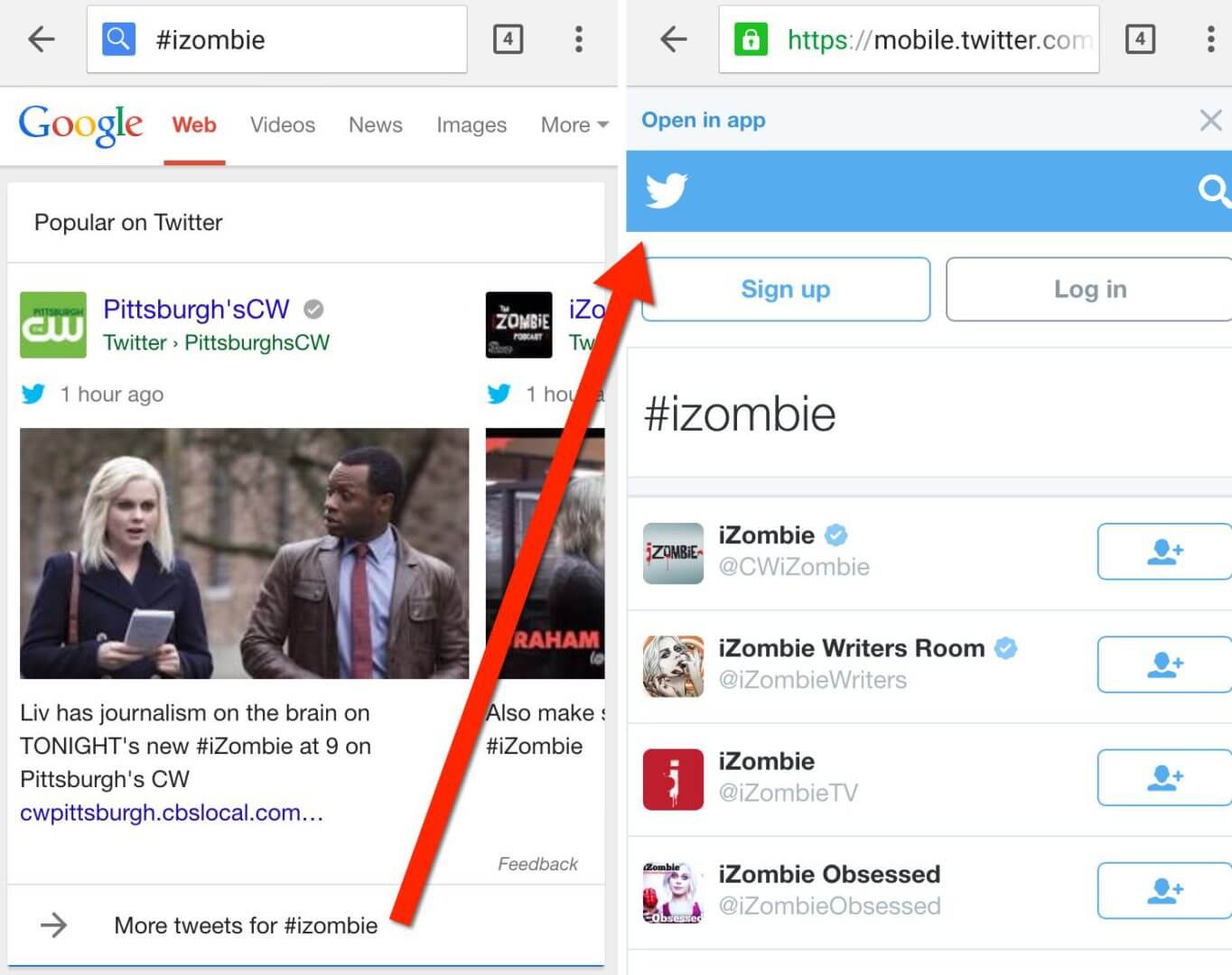
For example, as shown below, clicking on the “More Tweets” link associated with the new Twitter carousel at Google will launch Twitter on someone’s browser, where they can get see more tweets, see ads from Twitter and be encouraged to download the app or sign-up:
google to twitter
If you do have the app installed, and you’ve set it to handle links from Twitter, then that launches right into the Twitter app experience:
google tweets into app

When Twitter accounts are listed, those are also links that lead back to Twitter, as with this example for Taylor Swift:
google twitter taylor swift

Clicking on individual tweets also will launch Twitter from Google’s results.
It’s important to note that this is NOT tweets coming into Google for the first time, or the first time since the last formal deal ended. Tweets have continued to be in Google since that last deal. The new deal just allows for more of the and with deeper integration. Our past post explains more about this: FAQ: How Twitter’s New Deal To Bring Tweets To Google Search Works.

Mobile For Now, Desktop Promised

Right now, the new implementation will only be offered for those searching in the US, in English, using either their browser in iOS or Android or the Google Search App. Twitter promises support for desktop and other languages in the coming months.
For even more examples of how the new integration is working, see our companion story, 14 Examples Of The New Tweets Showing Up In Google Search.