Tuesday, 19 May 2015

The Google-Twitter Deal Goes Live, Giving Tweets Prominent Placement In Google’s Results

Tweets now appear for trending topics in a new carousel format. Twitter doesn't earn directly off display but will gain new traffic.


twitter-google-logos2-1920

The deal between Google and Twitter to bring more tweets into Google’s search results announced earlier this year is finally delivering on its promise. Google is now showing tweets in a new and more graphical way on mobile devices, with desktop promised soon.

Tweets In Carousel, With Images

Both Twitter and Google shared the news in blog posts today, with examples. Below, here’s our own example of how it looks for a search on #iZombie. There’s a “carousel” of tweets at the top of the page, where many of them show large images:
izombie
You can slide through the carousel to see other tweets, as shown below:
tweets in google

When, Where & Why Tweets Appear Uncertain

Tweets don’t always appear at the top of the page. Sometimes they might be elsewhere, such as the middle of the page, as this example for “MacBook Pro” shows:
macbook tweets on google
Sometimes, tweets might not appear at all. We asked Google about why tweets might show, what controls exactly where they show, if they’re showing all tweets for a query in chronological order or filtering in some way such as to block obscenity or to surface more popular tweets. The company wouldn’t answer any of those questions.
Google’s blog post on the deal does say:
It’s a great way to get real-time info when something is happening. And it’s another way for organizations and people on Twitter to reach a global audience at the most relevant moments.
So presumably, you’re more likely to see tweets in Google when a hashtag, topic, person or organization appears to be trending or is newsworthy.
For Twitter, Traffic
Twitter tells us that there’s no direct monetization involved. IE, no clicks on tweets at Google will earn Twitter any direct money. So what’s Twitter getting out of this, assuming it’s not being paid a large licensing fee from Google? Traffic.
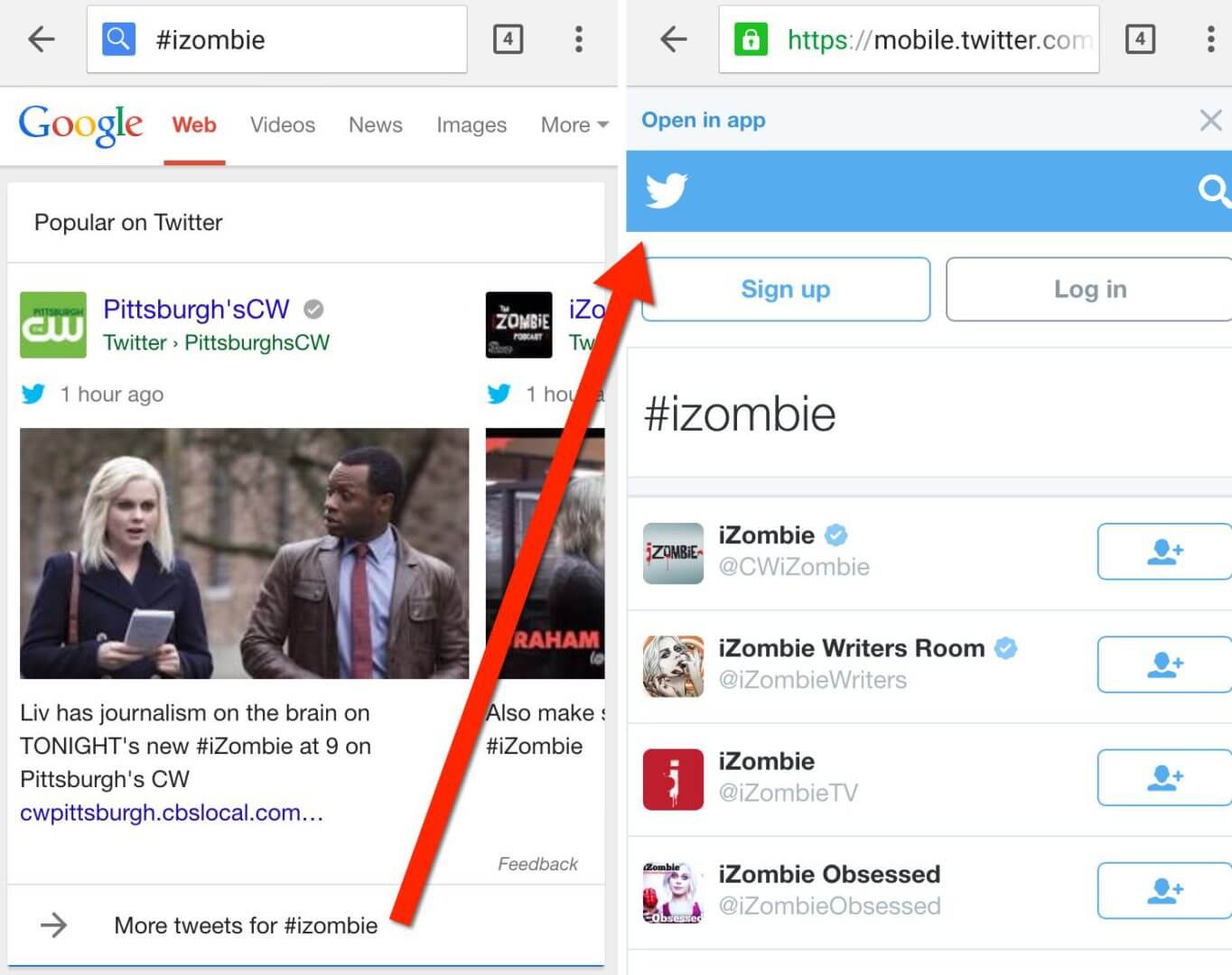
For example, as shown below, clicking on the “More Tweets” link associated with the new Twitter carousel at Google will launch Twitter on someone’s browser, where they can get see more tweets, see ads from Twitter and be encouraged to download the app or sign-up:
google to twitter
If you do have the app installed, and you’ve set it to handle links from Twitter, then that launches right into the Twitter app experience:
google tweets into app

When Twitter accounts are listed, those are also links that lead back to Twitter, as with this example for Taylor Swift:
google twitter taylor swift

Clicking on individual tweets also will launch Twitter from Google’s results.
It’s important to note that this is NOT tweets coming into Google for the first time, or the first time since the last formal deal ended. Tweets have continued to be in Google since that last deal. The new deal just allows for more of the and with deeper integration. Our past post explains more about this: FAQ: How Twitter’s New Deal To Bring Tweets To Google Search Works.

Mobile For Now, Desktop Promised

Right now, the new implementation will only be offered for those searching in the US, in English, using either their browser in iOS or Android or the Google Search App. Twitter promises support for desktop and other languages in the coming months.
For even more examples of how the new integration is working, see our companion story, 14 Examples Of The New Tweets Showing Up In Google Search.

Monday, 18 May 2015

Google “Phantom” Update Rolling Out Targeting Informational, ‘How-To’ Content

google-76517_640

NBC reports that an undisclosed, “phantom” algorithm update is rolling out in Google search right now which is primarily impacting publishers of “how-to” style content.
HubPages, a collection of more than 870,000 miniblogs containing informational content about wide varieties of topics, saw its Google search traffic drop 22 percent from one week to another on May 3.
Websites like eHow, WikiHow, and Answers.com are other sites that have seen significant drops in traffic over the past couple of weeks.
Glenn Gabe, of New Jersey-based G-Squared Interactive, is the one to coin the phrase “Phantom” update because this update came without warning, and Google has yet to acknowledge its existence.
Through analyzing the data, Gabe has determined that this udpdate is not related to Panda or Penguin. However, similar types of “thin” content targeted by Panda are also being targeted by this update.
Gabe points out that clickbait articles, sites with an abundance supplementary information, pages of stacked videos, and pages difficult to navigate have all lost visibility in recent weeks.
This update is said to be “ruthless” in its approach — apparently having no problem punishing entire domains for a few instances of thin content.
“When you have a domain-level algorithm update or ranking change, it can impact the whole site… Pages that should be drawing well could also be pulled down in the results.”
Google has not formally commented on this update, although at SMX Sydney this week Gary Illyes, from Google’s Webmaster Trends team, alluded to there being a recent change that’s part of a core algorithm update.
With Google’s Knowledge Graph being notorious for detracting traffic from sites for “how to” searches, coupled with this “Phantom” update, being a content publisher is more challenging than ever. Even Gabe, who analyzes search data for a living, admits to not being able to predict what business will look like tomorrow, next week, next month, etc.
Have you noticed a significant change in your traffic since the beginning of May? If so, what types of content do you believe was targeted? Details are scarce at this point, so any information we can get is valued.

Source: http://www.searchenginejournal.com/google-phantom-update-rolling-out-targeting-informational-how-to-content/132812/

Bing to Roll Out Its Own Mobile-Friendly Algorithm Update

Today, Bing published details about a future update that promises to improve how it delivers mobile-friendly search results to mobile searchers. Bing’s approach is not unlike Google’s, although there are some subtle differences.
smartphone-569076_1280
The key difference here is that Google gave a firm date as to when its mobile-friendly update would be rolled out, while Bing has opted to be a bit more vague. Bing has not given an exact date, other than to say it will be launched in the next few months.
Another difference is how Bing promises to maintain a balance between mobile-friendliness and relevance. Google’s mobile search results now exclude any page that’s not mobile-friendly, which may not necessarily be the case with Bing’s new algorithm.
Bing says that non-mobile-friendly web pages may still be included in mobile search results if the content contained within is determined to be the most relevant to the user’s query.
“While the changes will improve ranking for mobile-friendly pages, webpages that are highly relevant to the given query that are not yet mobile-friendly will not get penalized. This is a fine balance and getting it right took a few iterations, but we believe we are now close.”
This is intriguing, and I look forward to seeing in practice how well this works out from a user’s standpoint. Will users care how relevant a page is to their query if it’s not formatted to fit nicely on their screen? I suppose we’ll learn more when this eventually rolls out.

Bing’s Criteria For Determining Mobile-Friendliness

Bing detailed its criteria for ranking mobile friendly web pages. In addition, the company will soon be releasing a tool for testing whether or not your site meets Bing’s criteria.
  • Navigation – The menus, buttons and links on the page should be large enough and spaced well apart to aid touch-based navigation.
  • Readability – The text on the page should be readable without requiring zooming and lateral scrolling to access specific content.
  • Scrolling – The content of the web-page should fit within the device width, without the need for horizontal scrolling.
  • Compatibility – The content needs to be compatible with the device. For example, if the page contains a video it must be viewable on mobile devices.
All of the above factors will need to be in place in order for Bing to consider a website truly mobile-friendly.
This update will be rolled out “in the coming months”, and Bing says you can expect more details to be revealed leading up to the launch.
Source: http://goo.gl/obhhfp